
The right wheels depend far more on how you actually drive than on looks alone. Daily drivers benefit from lighter, moderately sized wheels paired with comfort-oriented tires. Off-road vehicles do best with smaller-diameter wheels and taller tire sidewalls for impact absorption. Tow-heavy trucks need wheels rated for the load, not just the style. How to Choose the Right Wheels for your situation really comes down to matching size, offset, material, and tire type to the driving you do most, rather than picking whatever looks best on the shelf.
Why Driving Style Should Drive the Decision
How to Choose the Right Wheels starts with an honest look at how the vehicle spends most of its time, not how it’s used on the occasional weekend. A wheel and tire package optimized for daily commuting will behave very differently off-road than one built for rock crawling, and a setup chosen purely for looks can quietly hurt ride comfort, fuel economy, or towing capacity.
Before comparing specific wheels, it helps to define the driving style honestly: mostly city and highway commuting, frequent off-road or trail use, regular towing or hauling, or a mix of several. Each of these calls for a different starting point in How to Choose the Right Wheels for your specific vehicle.
How to Choose the Right Wheels for Daily Driving
For vehicles that spend most of their time on pavement, comfort, quietness, and fuel efficiency usually matter more than an aggressive stance. Here’s how to choose the Right Wheels when highway and city driving make up most of the mileage:
- Stick close to factory wheel size and offset. Manufacturers tune ride quality and handling around a specific size, and straying too far can make the ride harsher without much real benefit.
- Choose lighter wheels where possible. Lowering unsprung weight with lighter wheels can slightly improve ride quality, steering response, and even fuel economy.
- Pair with all-season or touring tires. These prioritize a quiet ride and predictable handling over aggressive tread patterns you’ll rarely use.
- Avoid going too large in diameter. Larger wheels usually mean shorter tire sidewalls, which transmit more road imperfections into the cabin a trade-off daily drivers often regret after the first pothole.
This is one of the more straightforward parts of How to Choose the Right Wheels, since the safest bet is almost always to stay close to what the manufacturer has already engineered.
How to Choose the Right Wheels for Off-Road Use
Off-road driving changes the priorities completely. Here, How to Choose the Right Wheels means favoring durability and traction over a low-profile look:
- Favor smaller wheel diameters with taller tire sidewalls. A taller sidewall absorbs impacts from rocks and ruts, helping protect the wheel itself from damage.
- Consider steel or heavy-duty cast wheels. These hold up better to rock strikes and trail abuse than lighter, more delicate street wheels.
- Check offset for tire and suspension clearance. A more negative offset provides a wider stance and more room for larger tires, but usually requires confirming suspension clearance first.
- Match the tire to the terrain. All-terrain tires suit mixed use, while mud-terrain tires are better for serious off-road conditions but tend to be noisier and less efficient on the highway.
How to Choose the Right Wheels for Towing and Hauling
Trucks and SUVs that regularly tow or carry heavy loads have a different set of priorities, with safety margins that matter more than style. How to Choose the Right Wheels for this use case starts with load capacity, not appearance:
- Check the wheel’s load rating first. Any wheel under consideration should meet or exceed the vehicle’s payload and towing capacity, not just its curb weight.
- Avoid excessively large diameters. Bigger wheels often mean shorter tire sidewalls, which can transmit more heat and stress to the tire under heavy load.
- Stick close to factory offset. Towing puts extra side load on the suspension, so straying too far from the factory offset can add unnecessary stress on bearings and steering components.
- Choose load-range-appropriate tires. The tire’s load range needs to match the wheel and the vehicle’s towing needs, since even a strong wheel can be let down by an underrated tire.
How to Choose the Right Wheels for a Mixed-Use Vehicle
Many drivers don’t fit neatly into one category: a truck might tow occasionally, see light trails on weekends, and commute during the week. In this case, how to choose the Right Wheels usually means picking a balanced middle ground rather than optimizing hard for one use case:
- A mid-range wheel diameter (often the factory size or one step up) balances ride comfort with reasonable styling flexibility.
- A quality all-terrain tire offers a workable compromise between on-road manners and occasional off-road capability.
- Staying close to factory offset avoids most clearance and handling trade-offs while still allowing for a slightly bolder look.
Wheel Material: Does It Matter for Driving Style Too?
Material is often overlooked in How to Choose the Right Wheels conversations, but it plays a real role:
- Cast aluminum: the most common and affordable option, offering decent strength and a wide range of styles — a solid all-around choice for daily driving and mild off-roading.
- Forged aluminum: stronger and lighter than cast wheels for the same size, making them a good choice for performance-focused or weight-sensitive builds, at a higher price point.
- Steel: heavier but tougher and cheaper to repair after impacts, making it a practical pick for serious off-road use or budget-focused winter wheel setups.
- Flow-formed: a middle ground between cast and forged, offering improved strength and reduced weight over standard cast wheels at a more moderate price.
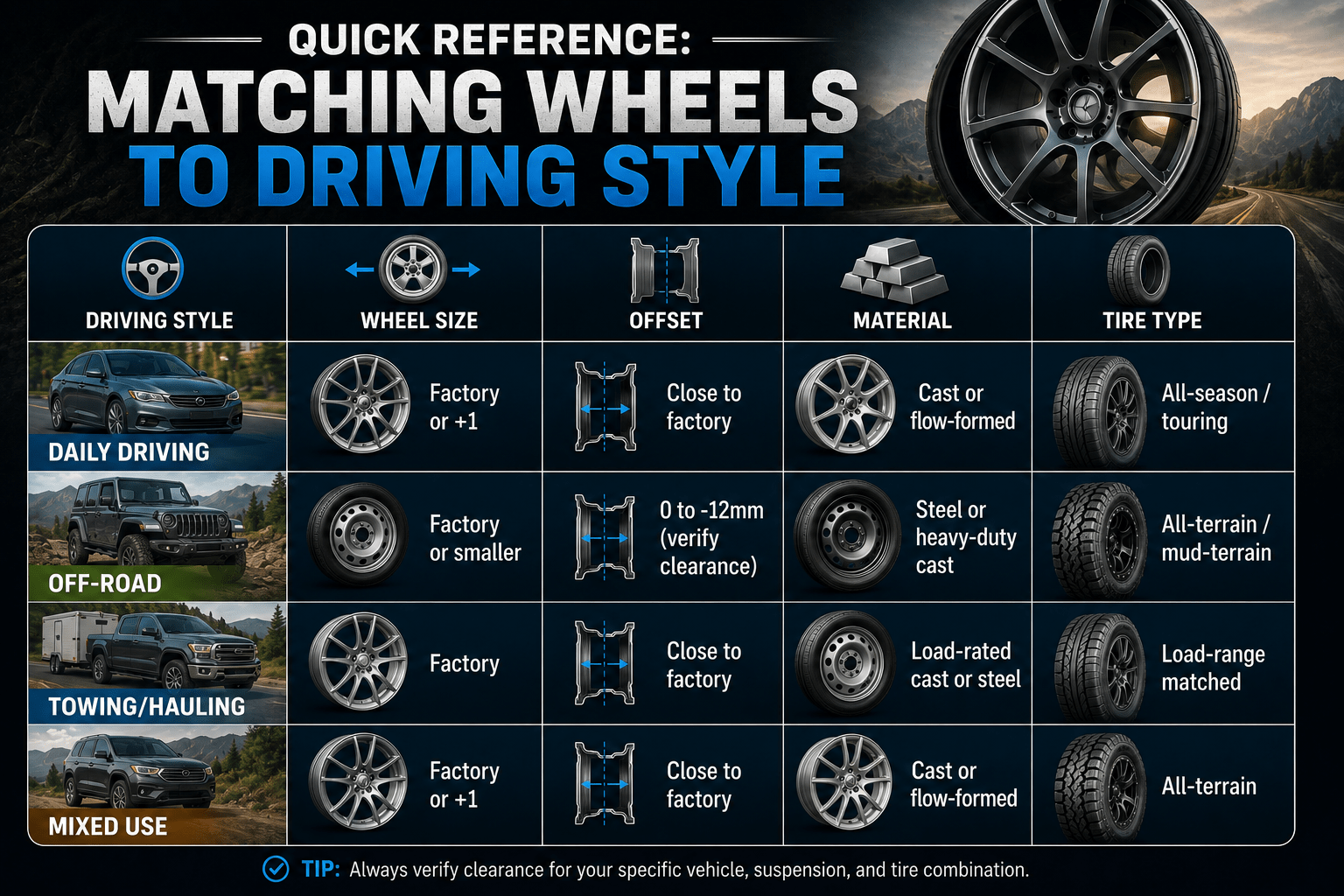
Quick Reference: Matching Wheels to Driving Style
The table below summarizes how to choose the Right Wheels for each of the main driving styles covered above:
Frequently Asked Questions
What’s the most important factor in choosing wheels? Matching the wheel and tire package to how the vehicle is actually driven matters more than any single spec. This is the core idea behind How to Choose the Right Wheels for any vehicle: a wheel that looks great but doesn’t suit your driving style can hurt ride comfort, fuel economy, or towing safety.
Should I choose bigger wheels for a better look, even if I mostly drive on the highway? You can, but it’s worth knowing the trade-offs first: larger wheels usually mean a shorter tire sidewall, which can make the ride harsher and slightly reduce fuel economy on daily-driven vehicles.
Do off-road wheels work fine for daily driving too? Often yes, especially with an all-terrain tire, though heavier off-road-focused wheels can very slightly affect ride quality and fuel economy compared with lighter street wheels.
How much does wheel material matter compared to size and offset? It matters, but usually less than getting size and offset right first. Material affects weight, durability, and cost, while size and offset determine whether the wheel fits and performs safely in the first place.
Is it safe to use the same wheels for towing and off-roading? Generally yes, as long as the wheel’s load rating covers the towing requirement and the tire is suited to both use cases. This dual-purpose scenario is a common real-world version of How to Choose the Right Wheels, and an all-terrain tire with an appropriate load range is a common compromise.
Final Thoughts
How to Choose the Right Wheels ultimately comes down to being honest about how a vehicle is actually driven, rather than choosing based on looks alone. Daily drivers benefit from staying close to factory specs with a focus on comfort, off-road vehicles need durability and tire clearance, and towing vehicles need to prioritize load rating above all else.
Once the driving style is clear, narrowing down size, offset, material, and tire type becomes much simpler, resulting in a setup that looks good and actually holds up to its intended use.