
Wheel backspacing is the distance, measured in inches, from a wheel’s mounting surface (the flat face that bolts to the hub) to its inner edge. It’s a direct, easy-to-visualize measurement of how far a wheel sits toward the vehicle’s suspension side. Wheel Backspacing is closely related to offset, but where offset uses millimeters and can be positive, negative, or zero, backspacing is always a plain positive number in inches, which is why many builders find it a more intuitive way to check clearance before buying wheels.
What Does Wheel Backspacing Actually Measure?
Wheel Backspacing is measured from the wheel’s mounting pad the flat surface that bolts directly to the hub to the wheel’s inner lip, the edge closest to the suspension and brakes. Picture a wheel lying flat on a table: if you place a straightedge across the back lip and measure straight down to the mounting surface, that distance is the backspacing.
Because it’s measured in inches from a fixed physical point rather than from an abstract centerline, Wheel Backspacing is often easier for people to picture than offset, especially when checking clearance against brake calipers or suspension arms by hand.

Wheel Backspacing vs Offset: What’s the Difference?
Wheel Backspacing and offset both describe how a wheel sits relative to the hub, but they measure it differently:
- Backspacing is always a positive number, measured in inches from the mounting surface to the wheel’s inner edge.
- Offset is measured in millimeters from the mounting surface to the wheel’s true centerline, and it can be positive, negative, or zero.
The two are mathematically connected through wheel width, so knowing any two of the three values (width, offset, backspacing) lets you calculate the third. A more positive offset generally means greater backspacing, while a more negative offset means less backspacing, but you can’t convert directly between backspacing and offset without also knowing the wheel’s width.
The Wheel Backspacing Formula
The standard formula for calculating Wheel Backspacing from a wheel’s width and offset is:
Backspacing (inches) = (Wheel Width ÷ 2) + (Offset in inches) + 0.5″
Since offset is normally given in millimeters, convert it to inches first by dividing by 25.4. For example, a 9-inch-wide wheel with a +25mm offset:
- Convert offset: 25mm ÷ 25.4 = 0.98 inches
- Half the wheel width: 9 ÷ 2 = 4.5 inches
- Add the constant: 4.5 + 0.98 + 0.5 ≈ 5.98 inches of backspacing
The same formula works in reverse if you already know the backspacing and need to solve for the offset, which is useful when comparing a new wheel’s backspacing to your current setup.
How to Measure Wheel Backspacing Yourself
If a wheel isn’t clearly labeled, Wheel Backspacing can be measured directly with basic tools:
- Lay the wheel flat, mounting surface facing up, on a level table or floor.
- Place a straightedge across the wheel’s back lip (the inner edge, opposite the mounting surface), resting on the true lip rather than any beadlock ring or flange.
- Measure straight down from the straightedge to the mounting surface with a ruler or tape measure, keeping the measuring tool perpendicular to the straightedge.
- Record the result in inches — that number is your backspacing.
- Double-check with the formula above if you also know the wheel’s width and offset, to confirm your manual measurement is accurate.
Why Wheel Backspacing Matters for Fitment
Getting Wheel Backspacing right isn’t just a technicality; it directly affects whether a wheel will physically fit your vehicle:
- Brake caliper clearance: too little backspacing can cause the wheel’s inner barrel to contact the brake caliper, especially on vehicles with larger factory brake packages.
- Suspension component clearance: insufficient backspacing can cause the wheel to strike control arms, tie rods, or coilovers during suspension travel or steering lock.
- Fender and tire clearance: too much backspacing pulls the wheel too far inward, which can affect how much of the tire sits outside the fender and change the vehicle’s stance.
- Load and handling: backspacing that’s significantly different from stock can shift how the tire’s contact patch loads the suspension, subtly affecting handling and tire wear over time.
Typical Wheel Backspacing Ranges
Because Wheel Backspacing depends on both wheel width and offset, there’s no single “correct” number across all vehicles, but a few general patterns hold:
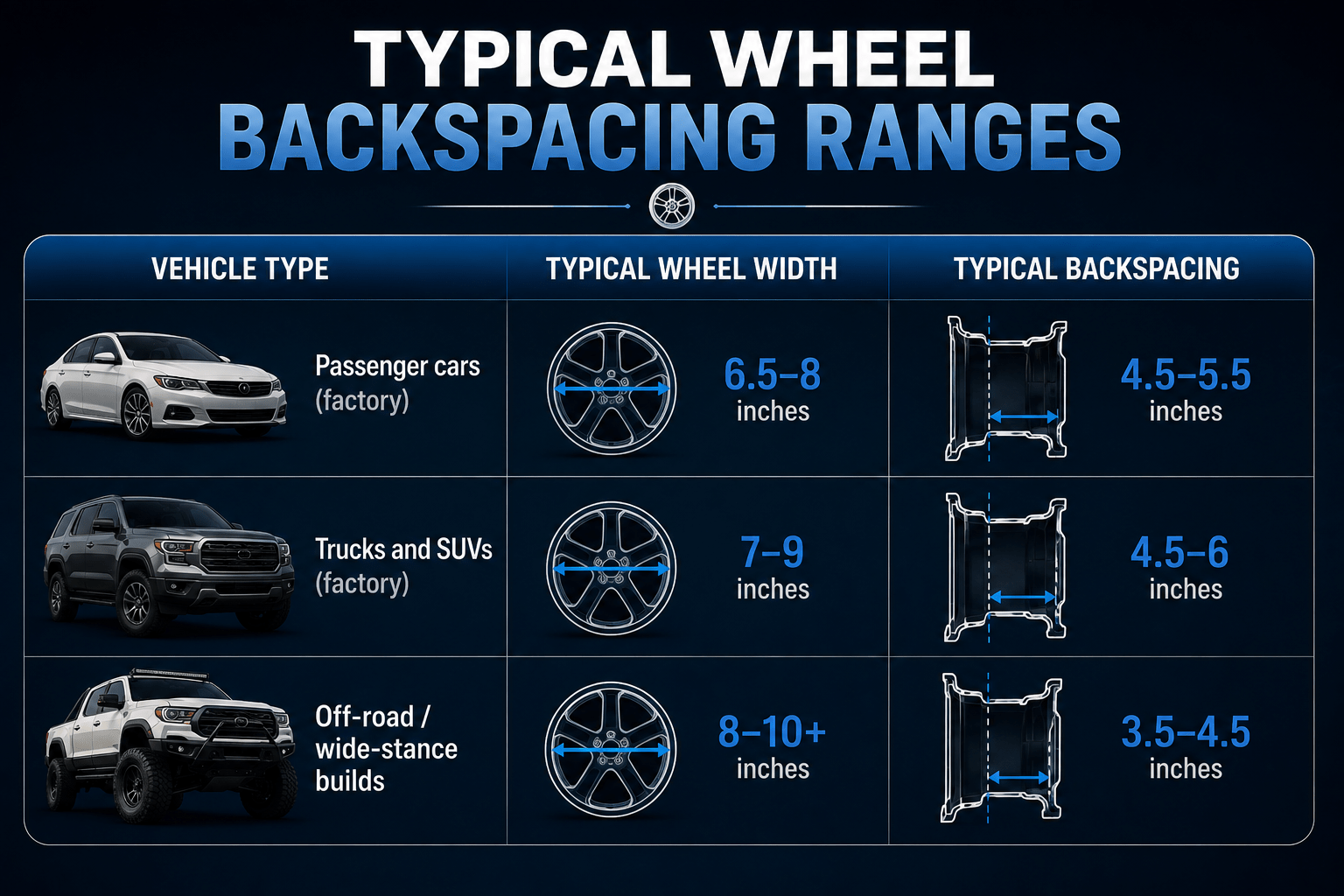
Lower backspacing numbers generally correspond to a wider, more aggressive stance (similar to a more negative offset), while higher backspacing numbers pull the wheel further inward, similar to a higher positive offset. These general ranges are a useful starting point, but always confirm the exact Wheel Backspacing your specific vehicle needs before buying.
Frequently Asked Questions
Is a higher or lower wheel backspacing better? Neither is universally better. Higher backspacing tucks the wheel further inward, which usually favors brake and suspension clearance, while lower backspacing pushes the wheel outward for a wider stance but increases the risk of rubbing against the fender.
How is wheel backspacing different from wheel offset? Backspacing is a positive number, measured in inches from the mounting surface to the wheel’s inner edge, while offset is a positive, negative, or zero value measured in millimeters from the mounting surface to the wheel’s centerline. Both describe wheel position, but from different reference points.
Can I calculate backspacing without removing the wheel? It’s difficult to get an accurate reading without removing the wheel, since you need clear access to both the mounting surface and the inner lip. If the wheel is still mounted, using the known offset and width to calculate Wheel Backspacing with the formula is usually more practical.
What backspacing do I need for a lifted truck? There’s no single universal number, since it depends on wheel width, tire size, and the amount of lift installed. As a general rule, lower backspacing (a wider stance) is common on lifted trucks to help clear larger tires, but exact clearance should always be confirmed for the specific setup.
Why does backspacing matter more than just wheel size? Wheel diameter and width describe how big a wheel is, but Wheel Backspacing describes exactly where that wheel sits relative to the hub — which is what actually determines whether it clears the brakes, suspension, and fender.
Final Thoughts
Wheel Backspacing might sound like a minor spec, but it’s one of the most practical numbers to check before buying new wheels, since it tells you directly whether a wheel will clear your brakes and suspension. Paired with offset and wheel width, it gives a complete picture of exactly how a wheel will sit once it’s installed.
Whether you’re replacing wheels with the same fitment or chasing a different stance, confirming backspacing either by measuring it directly or calculating it from offset and width is one of the simplest ways to avoid an expensive fitment mistake.