
Yes, in most cases, larger wheels reduce fuel economy by about 2% to 10%, depending on how much larger the wheel-and-tire package is and how the vehicle is driven. The main culprits are increased rolling resistance, added rotational mass, and sometimes a change in effective gearing. City driving usually sees a bigger penalty than steady highway cruising. The question of whether bigger wheels reduce fuel economy comes up constantly among drivers considering a “plus-size” wheel upgrade, and the honest answer is that it depends on exactly what’s being upgraded, but the effect is real and measurable in nearly every case.
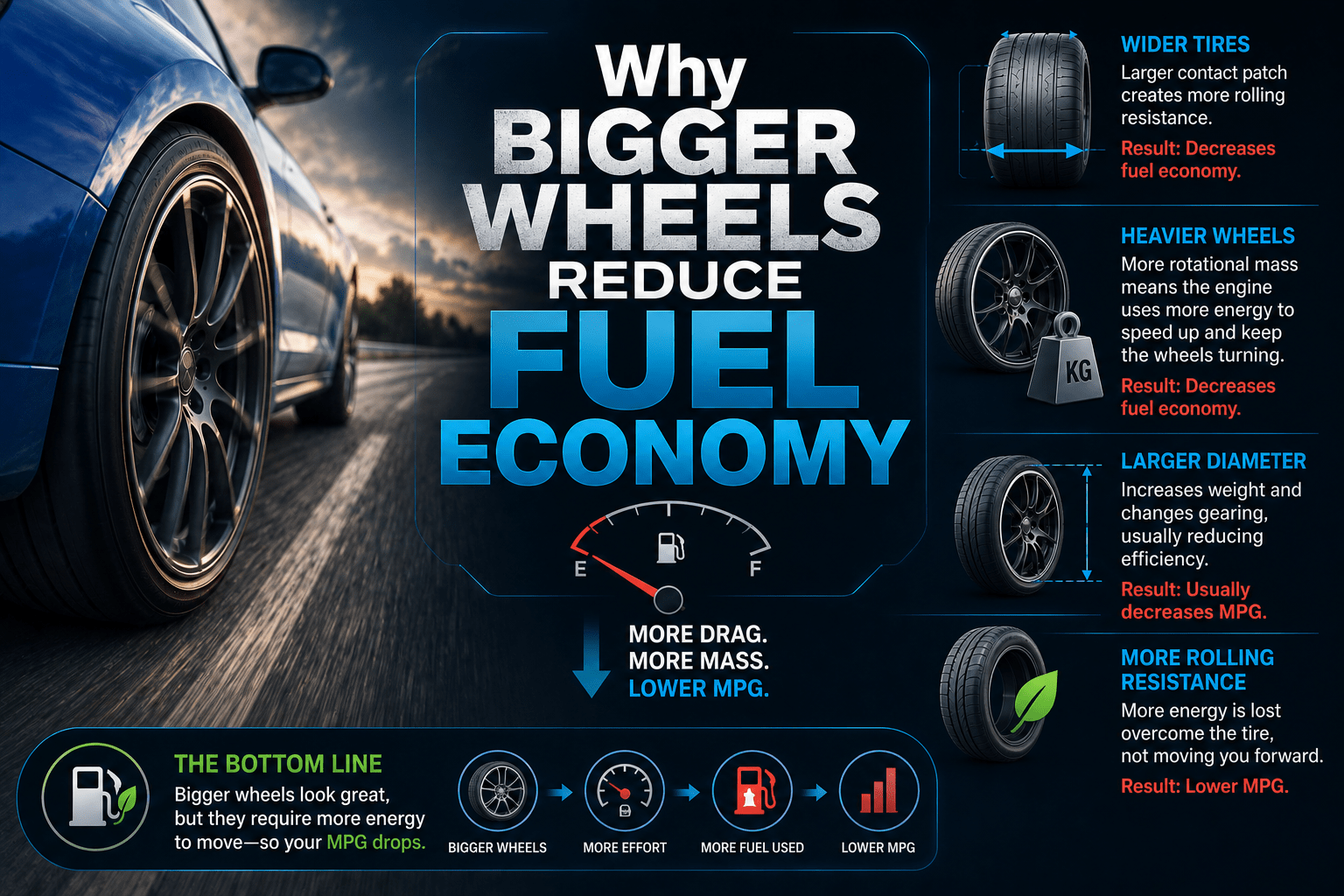
Why Bigger Wheels Reduce Fuel Economy
There are three main mechanical reasons behind the “Do Bigger Wheels Reduce Fuel Economy” effect, and they usually stack together rather than act alone.
Rolling Resistance
Wider tires, which typically come with larger wheels, create a larger contact patch with the road. That larger contact patch means more friction to overcome, so the engine has to work harder to keep the vehicle moving at the same speed. Rolling resistance is one of the most consistent factors behind the Do Bigger Wheels Reduce Fuel Economy effect, since it applies at virtually every speed and driving condition.
Rotational Mass and Unsprung Weight
Larger wheel and tire assemblies are usually heavier, and that added weight sits at the outer edge of a rotating object, which matters more than static weight elsewhere in the vehicle. Because rotational mass resists changes in speed more than ordinary weight does, some estimates suggest that removing one pound of rotating weight from a wheel can have an effect similar to removing several pounds of non-rotating weight from the vehicle overall. This is a major reason the “Do Bigger Wheels Reduce Fuel Economy?” answer skews so heavily toward “yes” in stop-and-go city driving, where the engine constantly has to accelerate and decelerate with that extra rotating mass.
Gearing and Overall Diameter
If a larger wheel is paired with a shorter-sidewall tire so the overall diameter stays the same, the effect on gearing is minimal. But if the total tire-and-wheel diameter increases, it effectively changes the vehicle’s gearing, which can push the engine outside its most efficient operating range. In some highway-driving cases, a taller overall diameter can very slightly help mpg by lowering engine RPM at cruising speed but this is the exception, not the rule, in the broader Do Bigger Wheels Reduce Fuel Economy picture, and it usually comes at the cost of reduced torque and slower acceleration.
How Much Fuel Economy Do You Actually Lose?
Real-world testing generally puts the “Do Bigger Wheels Reduce Fuel Economy?” number somewhere between 2% and 10%, depending on how much larger the new wheel-and-tire package is than stock. To put that in concrete terms: a car that normally gets 30 mpg might drop to somewhere between roughly 27 and 29.5 mpg after a noticeable wheel upsize.
Over a year of driving, that difference adds up. For someone driving around 15,000 miles annually, even a modest 2–5% drop in fuel economy can mean an extra 20–30 gallons of fuel consumed, which translates into real money depending on local gas prices.
City vs Highway: Does Driving Style Change the Answer?
Yes — where you drive changes how much the Do Bigger Wheels Reduce Fuel Economy effect actually costs you:
- City driving amplifies the penalty, since frequent acceleration and braking means the engine repeatedly has to overcome the extra rotational mass of larger, heavier wheels.
- Highway driving at a steady speed incurs a smaller rolling-resistance penalty, since the vehicle isn’t constantly accelerating and decelerating. Some heavy-duty vehicles may even see a very slight benefit from larger tires at consistent highway speeds.
- Mixed driving falls somewhere in between, which is why most published fuel economy drops are given as a range rather than a single fixed number, and why the honest Do Bigger Wheels Reduce Fuel Economy answer always comes with “it depends on how you drive.”
Can You Minimize the Fuel Economy Loss?
If you’re set on bigger wheels, there are ways to soften the Do Bigger Wheels Reduce Fuel Economy impact without giving up the look entirely:
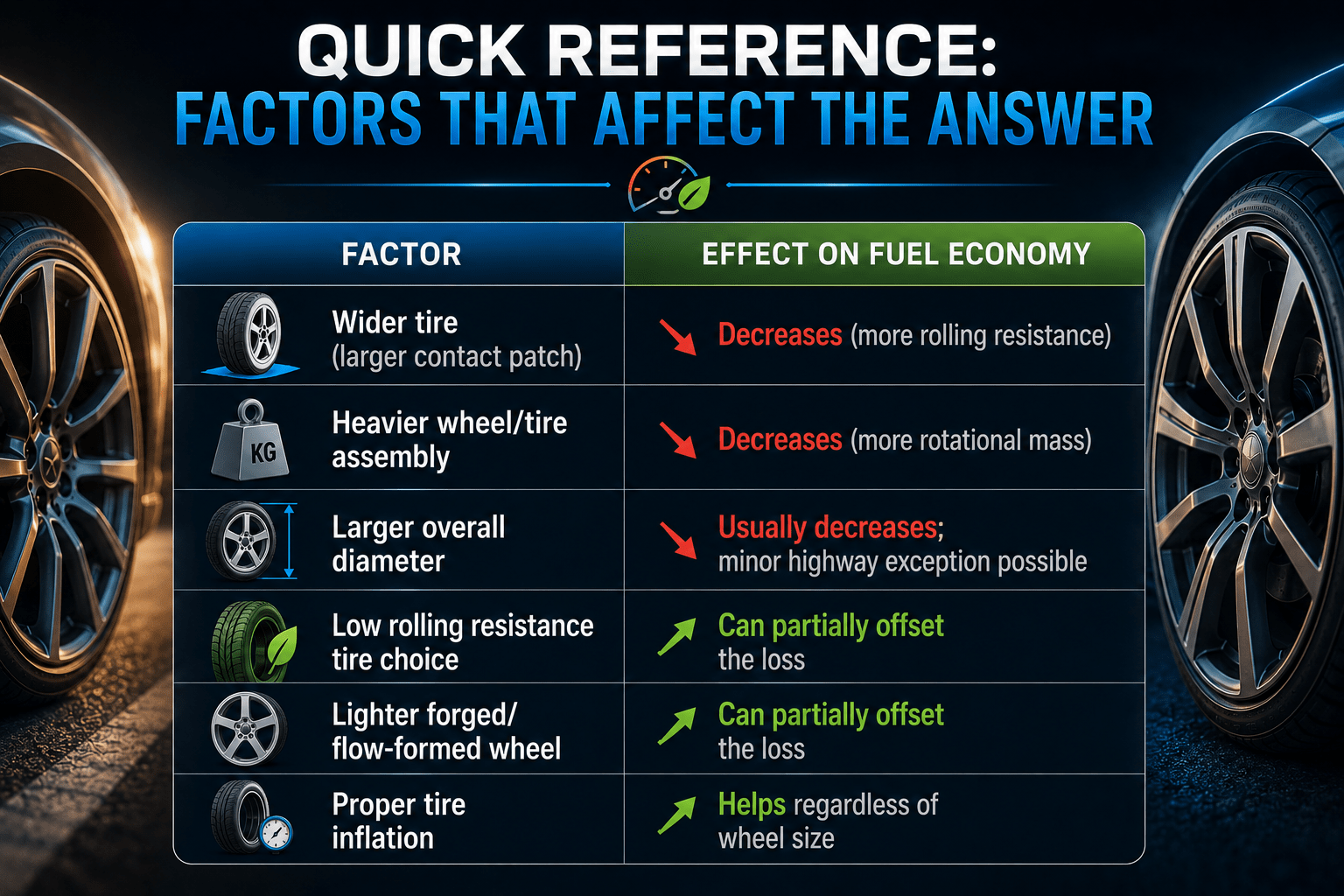
- Choose low rolling resistance tires. Tires engineered specifically to reduce rolling resistance can offset some of the mpg penalty that comes from simply going wider or taller.
- Keep the overall diameter close to stock. Pairing a larger wheel with a shorter-sidewall tire (plus-sizing) keeps gearing and speedometer accuracy close to factory, avoiding an additional efficiency penalty on top of rolling resistance.
- Go lighter, not just bigger. Forged or flow-formed wheels can be lighter than stock steel or cast wheels, even at larger diameters, reducing the added rotational mass that hurts city mpg the most.
- Keep tires properly inflated. Underinflated tires increase rolling resistance regardless of size, compounding any mpg loss from a larger wheel-and-tire package.
- Stick close to manufacturer-recommended sizing. Vehicles are engineered around a specific wheel-and-tire combination for efficiency, handling, and safety; straying far from that spec is what triggers the most noticeable effect: Do Bigger Wheels Reduce Fuel Economy?
Quick Reference: Factors That Affect the Answer
Frequently Asked Questions
Do bigger wheels always reduce fuel economy? In the large majority of cases, yes. The exception is a narrow scenario where a taller overall diameter slightly lowers highway RPM into a more efficient range, but this is uncommon and usually comes with a trade-off in torque and acceleration.
How much fuel economy do you lose with bigger wheels? Real-world tests generally show a 2% to 10% drop, depending on how much larger the new wheel-and-tire package is than stock, with city driving typically showing a bigger penalty than steady highway driving.
Does tire width matter more than wheel diameter for fuel economy? Both matter. Wider tires increase rolling resistance directly, while a larger wheel diameter often adds weight and can change effective gearing the combined effect is what drives the overall answer to the question of whether bigger wheels reduce fuel economy for any given upgrade.
Can lighter wheels offset the fuel economy loss from going bigger? Partially, yes. Since rotational mass has an outsized effect on fuel use compared with regular vehicle weight, choosing a lighter forged or flow-formed wheel can meaningfully soften, though not fully eliminate, the mpg penalty of a larger wheel.
Is the fuel economy loss worse in the city or on the highway? City driving typically shows a larger loss, since frequent stop-and-go driving requires repeatedly overcoming the extra rotational mass of bigger wheels — one of the clearest patterns in the Do Bigger Wheels Reduce Fuel Economy discussion. Highway driving at steady speeds sees a smaller effect from rolling resistance alone.
Final Thoughts
The Do Bigger Wheels Reduce Fuel Economy question has a fairly clear answer: yes, in most real-world cases, though the size of the hit depends on exactly how much bigger the wheel-and-tire package is and how the vehicle is driven. Rolling resistance and added rotational mass are the two biggest factors, and both get worse as wheels get wider, heavier, and taller.
That doesn’t mean bigger wheels are off the table it just means the trade-off is worth going in with eyes open. Choosing lighter wheels, low-rolling-resistance tires, and keeping the overall diameter close to stock are the most effective ways to enjoy a bolder look without taking the biggest possible hit at the pump.