
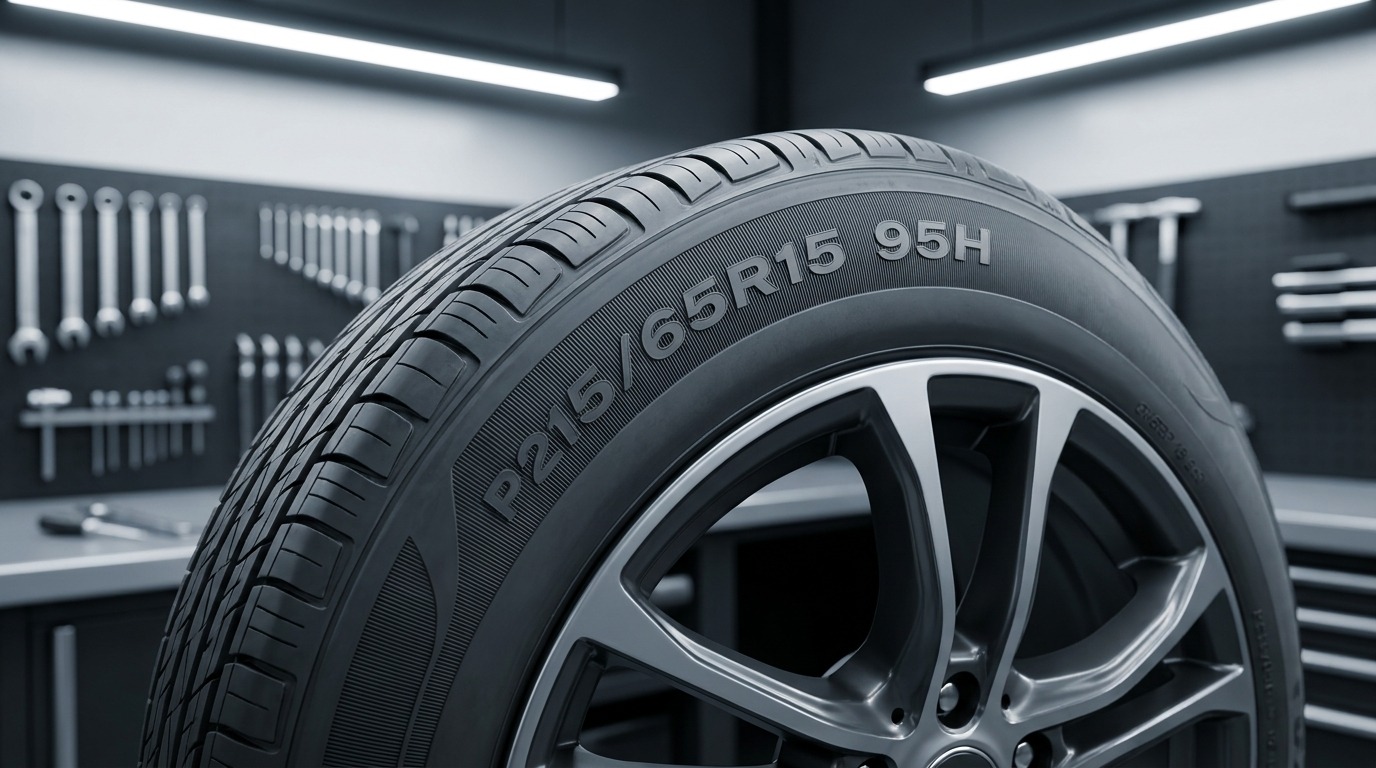
The string of letters and numbers on a tire’s sidewall, something like P215/65R16 95H, packs in the tire’s width, sidewall height, construction type, wheel diameter, load capacity, and top safe speed, all in one compact code. Learning to read Tire Size Codes takes a few minutes, but it’s one of the most useful skills for buying the right replacement tire and avoiding a mismatch with your wheels.
Why Tire Size Codes Matter
Every tire sold today carries a standardized size code molded directly into the sidewall. Tire Size Codes exist so that any tire shop, anywhere in the world, can look at that string and know exactly what fits a given vehicle no guesswork required.
Getting this code right matters for more than just fitment. A tire that doesn’t match the original spec can throw off your speedometer accuracy, change how your ABS and stability control systems behave, and in some cases even affect ground clearance and handling. That’s why understanding Tire Size Codes is worth the few minutes it takes to learn.
Breaking Down a Tire Size Code Step by Step
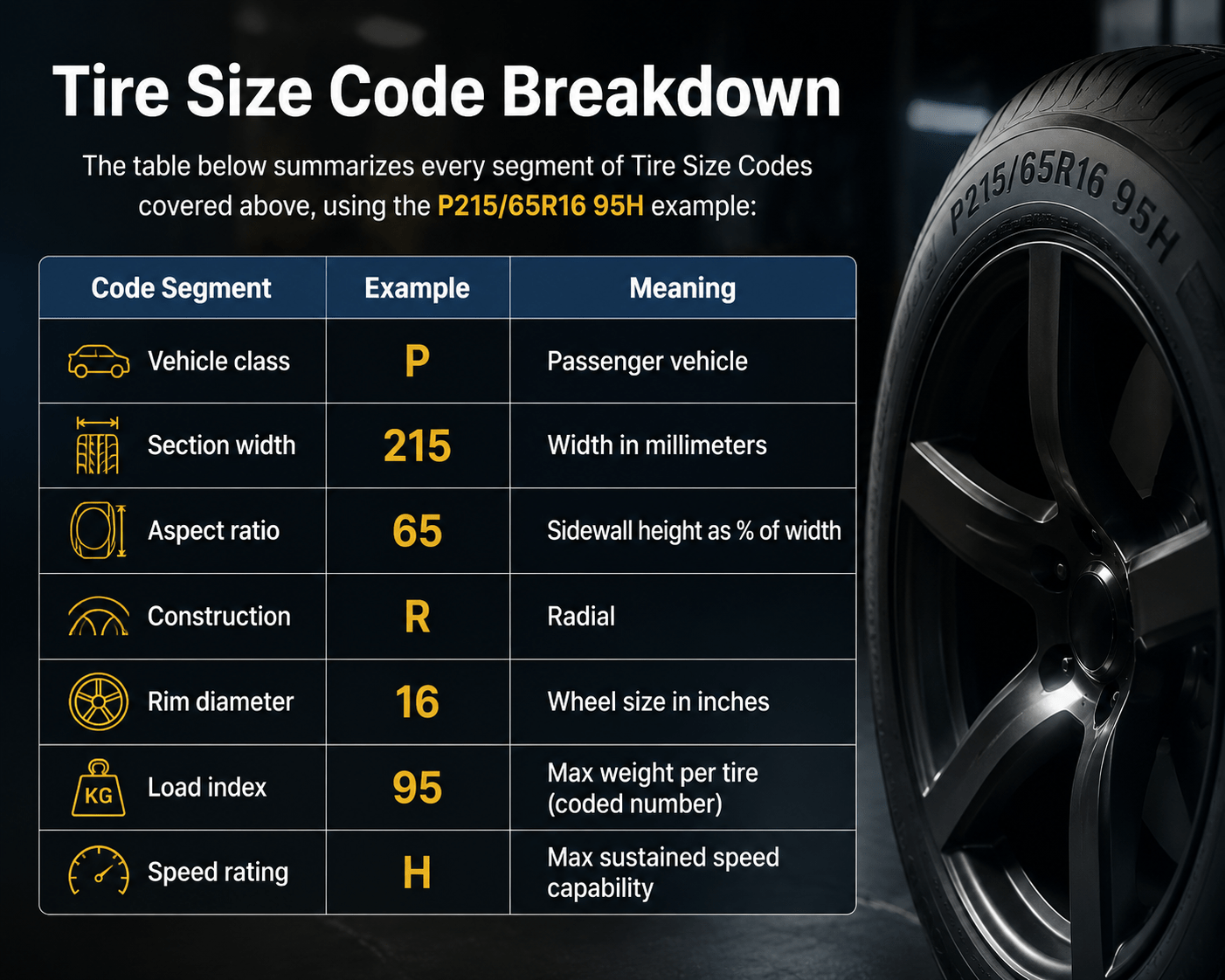
Using the common example P215/65R16 95H, here’s what each part of the code actually means:
1. Vehicle Class Letter (P, LT, ST, or T)
The first letter tells you what category of vehicle the tire is designed for:
- P — Passenger vehicle (cars, crossovers, minivans, smaller SUVs and pickups)
- LT — Light Truck, built for heavier loads and towing
- ST — Special Trailer, used on trailers and boat trailers
- T — Temporary, used on compact spare tires
Some tires, especially metric-sized truck tires, omit this letter entirely, which is normal and doesn’t indicate a fitment problem.
2. Section Width
The three-digit number right after the letter 215 in this example is the section width in millimeters, measured from sidewall to sidewall at the widest point. This is usually the first number people notice when they start learning to read Tire Size Codes.
3. Aspect Ratio
The two-digit number after the slash 65 in this example is the aspect ratio, expressing sidewall height as a percentage of section width. A higher aspect ratio means a taller, more cushioned sidewall, while a lower ratio means a shorter, stiffer sidewall built more for sharp handling. This is one of the parts of Tire Size Codes that most directly affects ride comfort.
4. Construction Type
The letter after the aspect ratio R in this example indicates internal construction. “R” stands for radial, the standard on virtually all modern passenger and light truck tires.
5. Rim Diameter
The number following the “R” 16 in this example is the wheel diameter in inches that the tire is designed to mount on. This number must match your wheel exactly, and it’s one of the parts of Tire Size Codes that leaves zero room for rounding or approximation.
6. Load Index
The two- or three-digit number after the size 95 in this example is the load index, a coded number that corresponds to the maximum weight the tire can safely carry when properly inflated. A load index of 95, for instance, corresponds to roughly 690 kg (1,521 lbs) per tire. Always match or exceed the load index your vehicle manufacturer specifies.
7. Speed Rating
The final letter H in this example is the speed rating, indicating the tire’s maximum sustained speed capability under proper load and inflation. Common passenger ratings include S, T, H, V, and higher performance letters, each corresponding to a specific top speed rating rather than a recommended everyday speed.
Tire Size Codes for Trucks and SUVs
Not every vehicle uses the same size format. Tire Size Codes on trucks and larger SUVs sometimes follow a different structure than standard passenger cars:
- LT-metric sizes (e.g., LT265/70R17) work similarly to P-metric codes but are built with reinforced sidewalls for heavier loads.
- Flotation sizes (e.g., 35×12.50R17) express overall tire diameter and width directly in inches rather than metric section width, which is common on off-road-oriented light truck tires.
If your vehicle currently uses a flotation-style size, converting it to an equivalent metric size (or vice versa) is best done with a size-comparison tool rather than assuming a rough match, since even small differences affect overall diameter and speedometer accuracy.
The DOT Date Code: How Old Is Your Tire?
Beyond the size itself, sidewalls also carry a DOT code that reveals the manufacturing date a detail that’s just as important as the Tire Size Codes themselves when buying used or long-stored tires. The last four digits of the DOT code show the week and year of manufacture: for example, “2419” means the 24th week of 2019. If only three digits are present, the tire predates 2000 and should not be used regardless of tread depth, since rubber compounds degrade with age even without visible wear.
How to Find Your Correct Tire Size
There are three reliable ways to confirm the right Tire Size Codes for your vehicle, without relying on guesswork:
- Check your owner’s manual, which lists the manufacturer’s recommended size and load rating.
- Look at the driver’s side door jamb sticker, which typically repeats the recommended size along with cold tire pressure specs.
- Read the sidewall of your current tires, if they’re already the correct factory-recommended size.
Frequently Asked Questions
What does the “R” mean in a tire size code? “R” stands for radial construction, where the internal plies run perpendicular to the direction of travel. It’s the standard construction type for nearly all modern passenger and light truck tires.
Can I use a tire with a higher load index than stock? Yes, a higher load index is generally safe and can even be beneficial for towing or hauling, but going lower than the manufacturer’s specification isn’t recommended, since it can lead to excessive flex and premature failure under normal loads.
Do I have to match the exact speed rating on my tires? It’s best practice to match or exceed the factory speed rating. A lower speed rating than specified can affect handling characteristics and isn’t recommended by most manufacturers, even if you never plan to approach that top speed.
What’s the difference between P-metric and LT tire sizes? P-metric tires are designed for standard passenger vehicles, while LT (Light Truck) tires use reinforced construction for heavier loads and towing. Both use similar Tire Size Codes formatting, but LT tires often have different load index ranges to reflect their higher capacity.
How do I know if my tire is too old to use safely? Check the DOT date code on the sidewall. Most manufacturers recommend replacing tires after about 6 to 10 years regardless of remaining tread, since the rubber compound degrades with age even on a tire that looks fine.
Where to Buy the Right Tires Once You Know Your Size
Once you’ve decoded your Tire Size Codes and confirmed the exact width, aspect ratio, rim diameter, load index, and speed rating your vehicle needs, the next step is finding a supplier that actually stocks that size in a quality brand. This is where a shop like Formula Wheel is worth considering — it’s a well-established, reputable retailer in Kuwait carrying a wide variety of tire brands and sizes alongside matching wheels, so you can confirm fitment and buy both in one place rather than guessing between separate sellers.
Final Thoughts
Tire Size Codes might look intimidating at first glance, but once broken into its individual parts vehicle class, width, aspect ratio, construction, rim diameter, load index, and speed rating the whole string becomes easy to read at a glance. Taking the time to understand it means you’ll never have to guess at the tire counter again, and you’ll be able to confirm that any replacement tire actually matches what your vehicle needs.