
Highway tires are the better pick if you mostly drive on paved roads and want a quieter ride, longer tread life, and better fuel economy. All-terrain tires are the better pick if you regularly leave the pavement for dirt, gravel, or light trails, since their more aggressive tread grips loose surfaces far better, even though that comes with more road noise and a small fuel economy penalty. The All-Terrain vs Highway Tires decision really comes down to being honest about where your tires actually spend most of their time.
What Makes All-Terrain and Highway Tires Different
The core of the All-Terrain vs Highway Tires comparison comes down to tread design. All-terrain (A/T) tires use larger tread blocks, deeper grooves, and softer rubber compounds to bite into mud, gravel, sand, and rocky surfaces. Highway (H/T) tires use a smoother, more closed tread pattern designed to minimize rolling resistance and road noise on pavement.
That single design difference cascades into nearly every other trade-off in the All-Terrain vs Highway Tires debate, from how quiet the cabin is at highway speed to how many miles you’ll get before the tread wears out.

All-Terrain vs Highway Tires: Ride Comfort and Noise
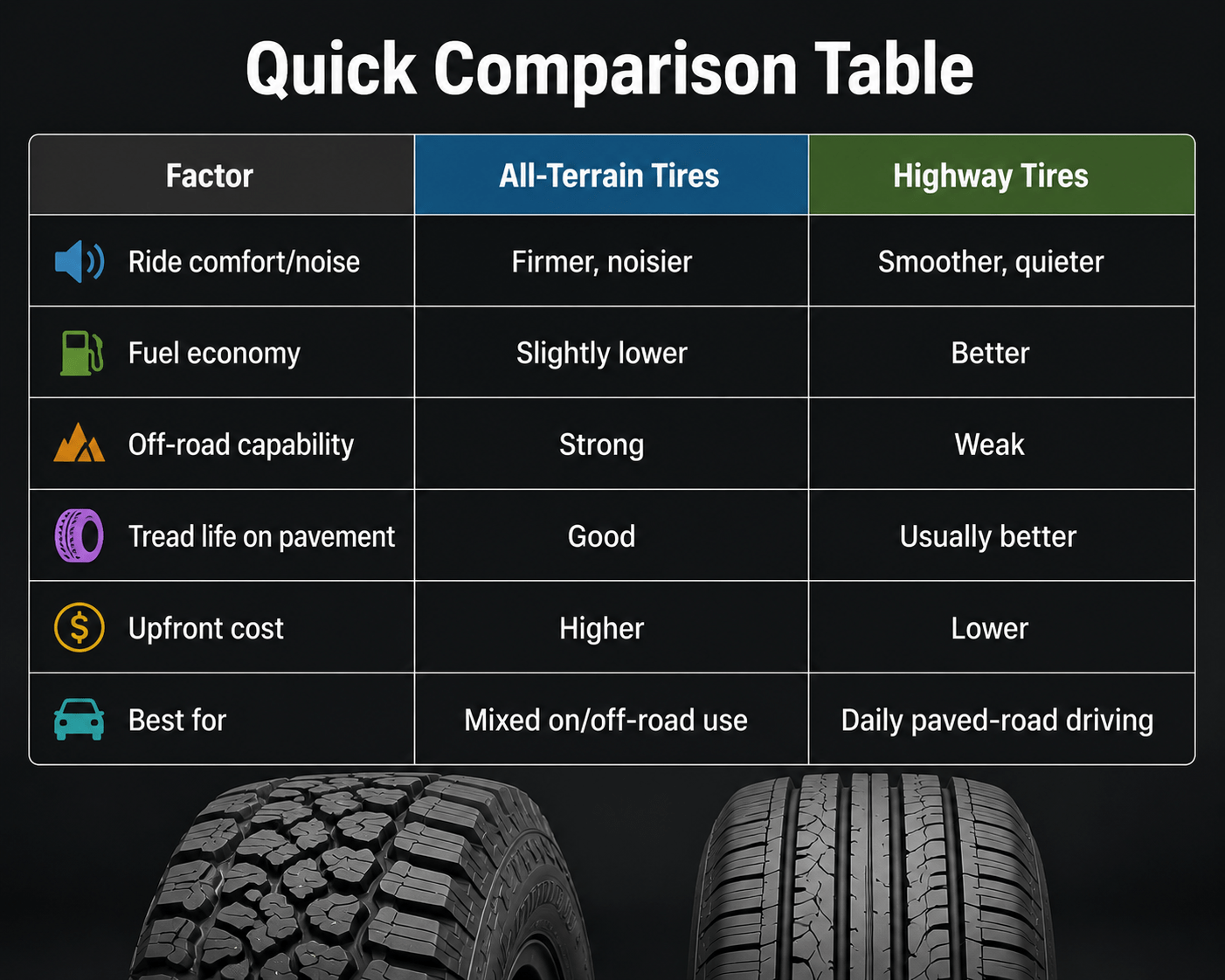
On paved roads, highway tires are noticeably quieter and smoother. Their tighter, more uniform tread pattern reduces the vibration and airflow noise that comes from tread blocks striking pavement at speed. All-terrain tires, with their larger and more widely spaced tread blocks, tend to produce more road noise and a firmer ride on the highway — a trade-off that’s noticeable on long commutes even if it isn’t a dealbreaker for most drivers.
This is one of the clearest, most immediately felt differences in the All-Terrain vs Highway Tires comparison, especially for anyone who spends hours a day on paved commutes.
All-Terrain vs Highway Tires: Fuel Economy
Highway tires generally win on fuel economy, since their smoother tread creates less rolling resistance. All-terrain tires typically show a measurable fuel economy penalty, often in the range of a few percentage points compared with a highway tire on the same vehicle because their more aggressive tread pattern generates more friction with the road.
That said, the gap isn’t universal. Some modern all-terrain tires are specifically engineered with lower rolling resistance compounds to narrow this difference, so the All-Terrain vs Highway Tires fuel economy gap has gotten smaller in recent years, even if highway tires still tend to come out ahead.
All-Terrain vs Highway Tires: Off-Road Capability
This is where the comparison flips decisively. All-terrain tires are built to handle mud, sand, gravel, and light rock without hesitation, thanks to their aggressive tread and reinforced sidewalls. Highway tires, by contrast, are optimized purely for paved surfaces and can struggle for traction the moment the road turns to dirt or loose gravel. This off-road gap is usually the single biggest factor separating the two sides of the All-Terrain vs Highway Tires decision.
If your driving includes any regular off-pavement time, even occasional dirt roads or gravel driveways, this single factor often settles the All-Terrain vs Highway Tires decision on its own, since a highway tire simply isn’t designed for that kind of surface.
All-Terrain vs Highway Tires: Durability and Tread Life
Highway tires are generally engineered for longer tread life on pavement, since their tread compound and pattern are optimized purely for road wear rather than durability against rocks and debris. All-terrain tires use tougher, more puncture-resistant construction to survive off-road hazards, but that added durability doesn’t always translate into longer tread life on regular pavement. This is often the most misunderstood part of the All-Terrain vs Highway Tires conversation, since “tougher” doesn’t automatically mean “longer-lasting” once you’re back on the highway.
In practice, this part of the All-Terrain vs Highway Tires comparison depends heavily on the specific tire model and how it’s driven, so checking a manufacturer’s mileage warranty is a more reliable guide than assuming one category automatically outlasts the other.
All-Terrain vs Highway Tires: Cost
All-terrain tires are typically more expensive upfront than comparable highway tires, reflecting their more durable construction and reinforced sidewalls. For drivers who never leave the pavement, that added cost in the All-Terrain vs Highway Tires choice may not be worth paying for, since the off-road capability will simply go unused. Comparing real, current prices from a trusted retailer is the best way to see exactly how much this trade-off costs in practice.
Which Side of the All-Terrain vs Highway Tires Decision Fits You?
- Choose highway tires if you drive almost exclusively on paved roads and want the quietest ride, best fuel economy, and lowest cost for daily driving or commuting.
- Choose all-terrain tires if you regularly encounter dirt, gravel, or light trails; even if most of your driving is still on pavement, the added grip and durability are worth the trade-offs in noise and fuel economy.
- Consider a fuel-efficient A/T model if you want a middle ground; several modern all-terrain tires are specifically engineered to narrow the fuel economy and noise gap without giving up off-road capability.
For most SUV and truck owners weighing the All-Terrain vs Highway Tires question, the honest answer comes down to how often the vehicle actually leaves the pavement, not how it’s marketed or how it looks on the shelf.
Frequently Asked Questions
Are all-terrain tires worth it if I rarely go off-road? Probably not. If your driving is almost entirely on pavement, a highway tire will generally give you a quieter ride, better fuel economy, and lower cost without sacrificing anything you’d actually use.
Do all-terrain tires really hurt fuel economy that much? The penalty is usually modest, often just a few percentage points compared with a highway tire, though it can be larger with more aggressive tread designs. Choosing a fuel-efficient A/T model can narrow this gap significantly.
Can highway tires handle occasional dirt roads? To a limited degree, yes, but they’re not designed for it. If dirt or gravel roads are a regular part of your route, an all-terrain tire will perform noticeably better and more safely.
Which lasts longer, all-terrain or highway tires? It depends on the specific tire model more than the category. Highway tires are generally optimized for pavement tread life, while all-terrain tires are built tougher against off-road hazards — checking the manufacturer’s mileage warranty is more reliable than assuming either category wins by default.
Is there a tire that combines the benefits of both? Not perfectly, but many all-terrain tires today are designed to minimize noise and fuel economy penalties while keeping off-road capability, making them a reasonable middle ground for mixed-use drivers who don’t want to compromise entirely.
Where to Buy the Right Tires for Your Driving Style
Whichever side of the All-Terrain vs Highway Tires decision fits you best, the next step is finding a supplier that actually stocks both categories in trusted brands. Formula Wheel is a well-established tire and wheel retailer in Kuwait that carries a wide range of both all-terrain and highway tire options, so you can compare real products side by side and get expert advice on which fits your specific vehicle and driving habits, rather than guessing from a spec sheet alone.
Final Thoughts
The All-Terrain vs Highway Tires choice isn’t about which tire is objectively better; it’s about matching the tire to how the vehicle is actually driven. Highway tires win on comfort, quietness, fuel economy, and cost for pavement-only driving, while all-terrain tires earn their keep the moment dirt, gravel, or light trails become part of the routine.
Being honest about your actual driving pattern, rather than the driving you occasionally imagine doing, is the simplest way to land on the right side of this decision.