
Most tire manufacturers recommend replacing tires by 6 to 10 years from the manufacture date, regardless of remaining tread, since rubber degrades with age even on a tire that’s rarely driven. On top of that age limit, tires should be replaced whenever tread depth drops to 2/32 of an inch (the legal minimum in most places), or sooner if you spot cracking, bulges, or uneven wear. How Often Should You Replace Your Tires really comes down to checking three things together: tread depth, age, and overall condition, rather than relying on mileage alone.
Why Mileage Alone Doesn’t Answer the Question
It’s tempting to think how often you should replace your tires is simply a mileage question, but mileage alone is misleading. Most tires last somewhere between 25,000 and 80,000 miles depending on tire type, driving habits, tire pressure, and rotation schedule, a wide enough range that mileage alone can’t reliably answer how often you should replace your tires for any specific vehicle.
A tire with only 20,000 miles on it can still need replacing at the 10-year mark, because rubber compounds break down from heat, UV exposure, and oxidation whether the tire is driven or not. On the flip side, a tire that’s racked up high mileage with worn tread needs replacing even if it hasn’t hit its age limit yet.
Tire Age: The Rule Most Drivers Overlook
One of the most overlooked parts of how often you should replace your tires is the age rule. Most major manufacturers recommend having tires inspected carefully once they reach 5 to 6 years old, and replaced outright by 10 years from the manufacture date, no exceptions, regardless of how much tread is left.
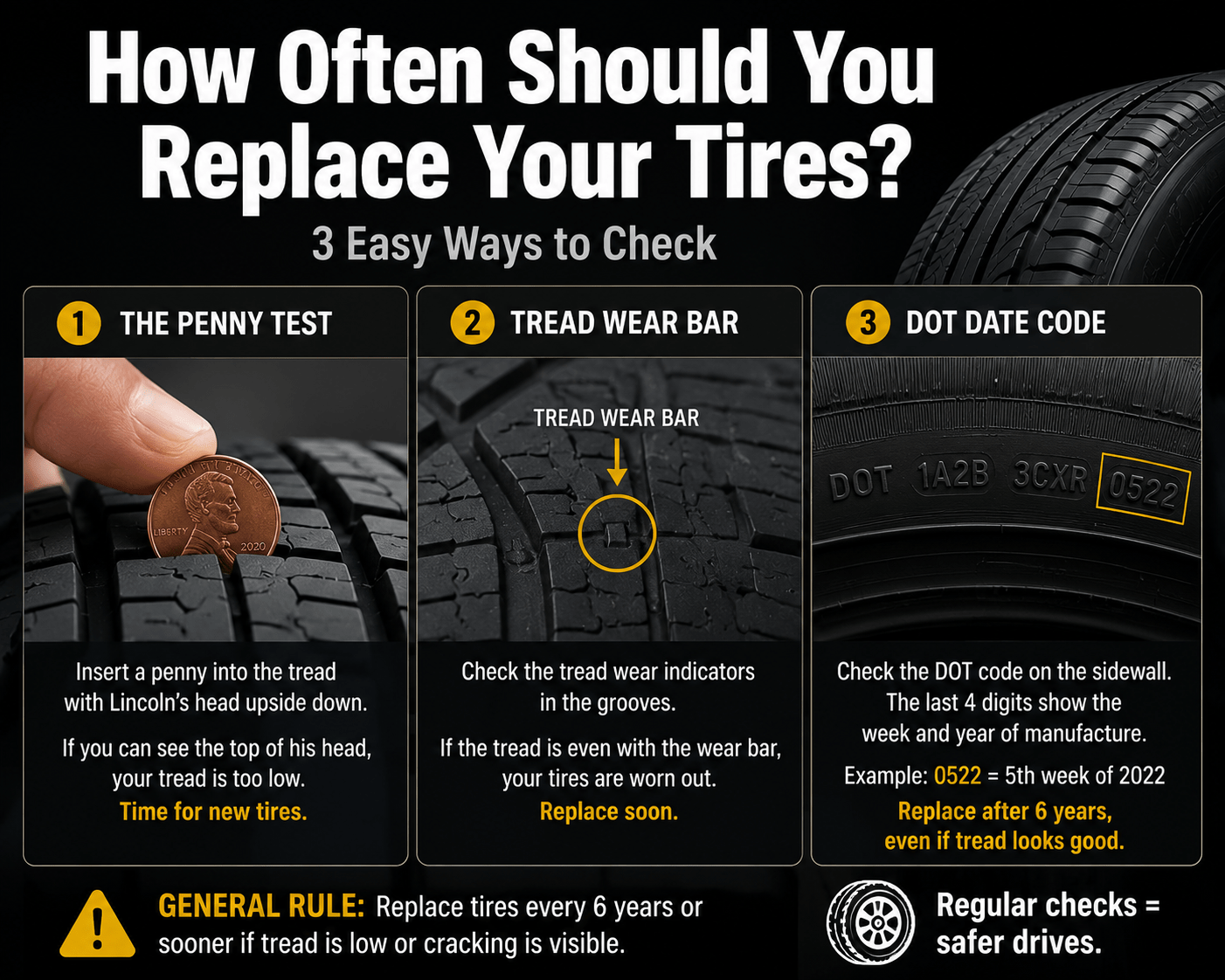
To find a tire’s exact age, check the DOT code molded into the sidewall. The last four digits show the week and year of manufacture: for example, “2419” means the 24th week of 2019. If your tire only shows three digits in that spot, it was made before 2000 and should be replaced immediately, no matter how the tread looks. Checking this code is one of the fastest ways to answer how often you should replace your tires for any specific set sitting in your garage.
Tread Depth: The Penny (and Quarter) Test
Tread depth is the other half of How Often Should You Replace Your Tires, and it’s easy to check at home using one of these three methods:
- The penny test: insert a penny into a tread groove with Lincoln’s head pointing down. If the top of his head is fully visible, your tread has dropped to 2/32 of an inch or less, the legal minimum in most places, and it’s time to replace the tire.
- The quarter test: using Washington’s head instead of Lincoln’s checks for a slightly higher 4/32-inch threshold, which some experts recommend as a safer replacement point, especially before wet or winter driving.
- Wear bars: Most modern tires also have built-in tread wear indicators molded into the grooves. When the tread surface is level with these bars, the tire has reached the end of its safe service life.
6 Warning Signs It’s Time for New Tires
Beyond the basic age and tread rules, a few warning signs mean it’s time to stop asking How Often Should You Replace Your Tires in the abstract and just replace them now. These six signals apply regardless of what the calendar or odometer says:
- Tread level with the wear bars is a clear, built-in signal that tread depth has reached its legal and safety limit.
- Visible cracking on the sidewall is often a sign of age-related rubber degradation, even if tread still looks fine.
- Bulges or blisters indicate internal structural damage and can lead to a sudden blowout.
- Uneven wear across the tread often points to alignment, suspension, or inflation issues that are shortening tire life.
- A DOT code showing 6+ years of age is a signal to start careful inspections even if the tire looks visually fine.
- Frequent air loss or vibration can indicate internal damage that isn’t visible from the outside.
How Often Should You Replace Your Tires Based on Mileage?
While mileage shouldn’t be the only factor, it’s still a useful general guide once tread and age are also accounted for. The table below rounds out the mileage side of How Often Should You Replace Your Tires by tire type:
| Tire Type | Typical Mileage Life |
|---|---|
| Highway/touring tires | 50,000–80,000 miles |
| All-season passenger tires | 40,000–60,000 miles |
| All-terrain tires | 40,000–60,000 miles |
| High-performance tires | 25,000–40,000 miles |
These ranges vary with driving habits, alignment, tire pressure, and rotation schedule, so they should be treated as a rough guide rather than a fixed rule.
Should You Replace All Four Tires at Once?
Not always, but it’s often the safer choice, and it’s part of the practical side of how often you should replace your tires that goes beyond just checking a single tire in isolation. If you’re only replacing two tires, the new pair should go on the rear axle regardless of whether your vehicle is front-, rear-, or all-wheel drive, since better tread at the back reduces the risk of losing control in wet conditions. If tread and age are close across all four tires, which is common, replacing all four together keeps handling balanced and avoids repeating the same question again a few months later.
Frequently Asked Questions
How often should you replace your tires if you don’t drive much? Even with low mileage, tires should still be inspected carefully at 5 to 6 years and replaced by 10 years from the manufacture date, since rubber degrades with age regardless of how many miles are actually driven. This is one of the most common exceptions people miss when thinking through How Often Should You Replace Your Tires.
Can tires look fine but still need replacing? Yes. Tread can look adequate while the rubber itself has hardened and cracked internally from age, heat, and UV exposure. This is why the DOT date code matters just as much as tread depth.
What’s the minimum legal tread depth? In most places, the legal minimum is 2/32 of an inch, which the penny test is designed to check. Some experts recommend replacing at a slightly higher 4/32 of an inch for extra safety margin, especially in wet or winter conditions.
Is it dangerous to drive on tires older than 10 years? Yes, most manufacturers consider 10 years the outer limit regardless of tread depth, since aged rubber becomes more brittle and prone to sudden failure, including blowouts.
Do all four tires need to be replaced together? Not necessarily, but if only replacing two, the newer pair should go on the rear axle for stability. If all four tires are close in age and tread, replacing them together is usually simpler and safer than staggering replacements and repeating the how often you should replace your tires question again a few months later.
Where to Get Your Tires Inspected and Replaced
If you’re unsure how any of this applies to your specific tires, the safest move is a professional inspection rather than guessing from a sidewall code alone. This is exactly the kind of question about how often you should replace your tires that a trained technician can answer in minutes with the right tools. Formula Wheel is a well-established tire and wheel retailer in Kuwait that can check your tread depth, age, and overall condition, and offers a wide range of replacement tire brands and sizes in stock if it’s time for new rubber.
Final Thoughts
How Often Should You Replace Your Tires doesn’t have a single fixed answer, but the combination of tread depth, tire age, and visible condition gives a reliable picture in almost every case. As a general rule, plan on replacing tires by 6 to 10 years from manufacture regardless of tread, and sooner if tread hits 2/32 of an inch or you spot cracking, bulges, or uneven wear.
Checking these details every few months takes only a few minutes, and it’s one of the simplest ways to avoid a dangerous blowout or loss of grip when it matters most.