
Selecting the right Land Cruiser LC300 wheel and tire size matters when upgrading one of Toyota’s most capable SUVs. The factory wheel and tire combination balances ride comfort, steering response, braking, clearance, and overall vehicle stability. Changing the wheel diameter or installing larger tires can significantly change that balance.
For LC300 owners, the right setup depends on how you use the vehicle. A daily-driven Land Cruiser needs different priorities from one that regularly travels through the desert or is built for technical rock crawling.
Before choosing 33, 35, or 37-inch tires, understand the factory wheel options and how wheel diameter, tire sidewall, Offset, Lift, and Spacers work together.
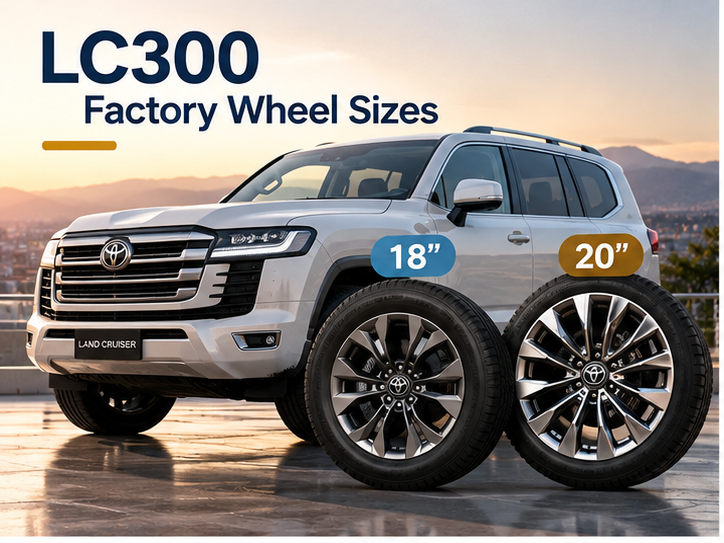
What Are the Factory LC300 Wheel Sizes?
Land Cruiser LC300 wheel and tire specifications vary by market, model year, and trim level. Factory configurations can include 18- and 20-inch wheels, depending on the vehicle.
The factory setup is engineered around:
- Vehicle weight
- Brake clearance
- Ride comfort
- Steering response
- Tire load capacity
- Overall stability
Always check your LC300’s exact specifications on the driver’s-door label, in the owner’s manual, or on the current tire sidewall before buying replacement wheels or tires.
This is especially important because two LC300 vehicles from different markets or trims may not have identical factory specifications.
Can You Install 17-Inch Wheels on an LC300?
A 17-inch wheel can be attractive for off-road builds because it allows a taller tire sidewall when the overall tire diameter is appropriate.
However, choosing a smaller wheel doesn’t guarantee compatibility.
The wheel must have sufficient clearance around the LC300’s brake components and must also have the correct:
- Bolt pattern
- Wheel width
- Offset
- Load capacity
- Brake clearance
If a specific 17-inch wheel has been properly confirmed for the LC300, it can provide a useful platform for desert-oriented tires and other off-road applications.
18 vs 20 Inch Wheels on the LC300
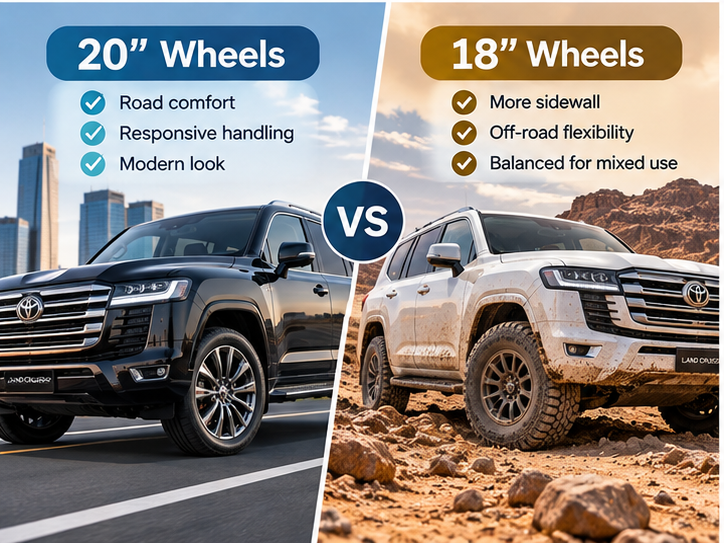
For many owners, the choice between 18 and 20 inches is more about intended use than appearance.
A 20-inch wheel can deliver a sharp, road-oriented look and responsive handling when paired with the right tire. However, a lower-profile tire generally provides less sidewall cushioning over rough terrain.
An 18-inch wheel can offer more sidewall with the right tire size, making it attractive for mixed road and off-road use.
For an LC300 that spends most of its time on highways and city roads, 20 inches may be perfectly suitable. For frequent desert trips, an 18-inch setup can offer a useful balance between road manners and off-road flexibility.
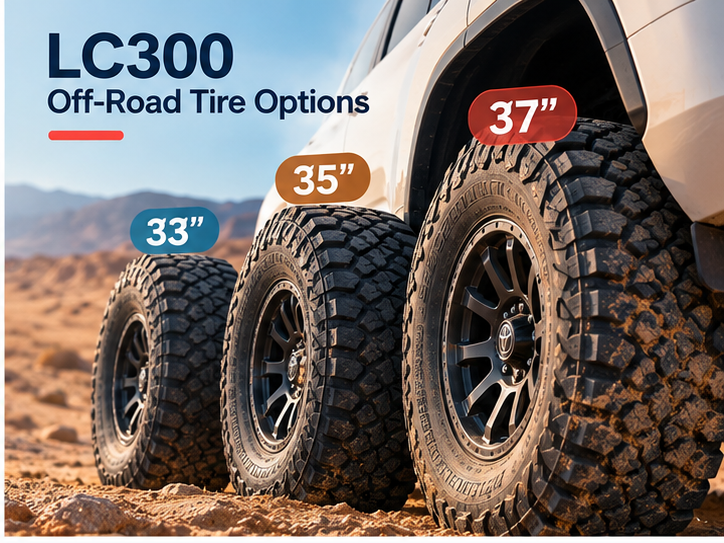
What About 33-Inch Tires?
A 33-inch tire is a relatively moderate upgrade for an LC300 compared with 35 or 37 inches.
Depending on the exact tire dimensions and wheel setup, it can provide additional ground clearance and sidewall without requiring the same level of modification as a much larger tire.
A 33-inch setup can be a practical choice for owners who want:
- More ground clearance
- Improved light off-road capability
- More sidewall
- A balanced daily-driving setup
Exact fitment still needs to be checked for the particular wheel, Offset, tire width, and suspension configuration.
Moving to 35-Inch Tires
A 35-inch tire is a more serious modification.
The larger diameter and width can affect clearance around the fenders, suspension, steering components, and inner wheel wells.
Depending on the exact LC300 configuration, owners may need to consider:
- Suspension Lift
- Wheel Offset
- Tire width
- Fender clearance
- Steering clearance
- Alignment
The key point is to plan a 35-inch tire with the wheel, not select it independently.
Can the LC300 Run 37-Inch Tires?
A 37-inch setup moves the LC300 into a more heavily modified category.
At this size, you must evaluate clearance throughout steering and suspension movement—not just when the vehicle is parked.
A 37-inch tire can also affect:
- Acceleration
- Braking
- Fuel consumption
- Steering effort
- Speedometer accuracy
- Drivetrain load
For a dedicated off-road LC300, these compromises may be worthwhile. For a daily driver, a smaller setup can often provide a better overall balance.
LC300 Wheel & Tire Fitment Comparison
| Setup | Wheel Size | Tire Size | Best For | Lift | Spacer | Main Consideration |
|---|---|---|---|---|---|---|
| Factory | 18–20″ | Factory size | City & Highway | No | No | Best factory balance |
| Mild Off-Road | 18″ | 33″ | City + Desert | Usually No* | Usually No* | Good balance and clearance |
| Desert Focus | 17–18″ | 33–35″ | Sand & Desert | May be needed* | Depends on Offset* | More sidewall and off-road flexibility |
| Serious Off-Road | 17–18″ | 35″ | Desert + Technical Trails | Often considered* | Depends on fitment* | Check full steering and suspension clearance |
| Extreme Build | 17–18″ | 37″ | Rock Crawling | Typically Required* | May be required* | Major fitment and suspension planning |
Important: Lift and Spacer requirements cannot be determined by tire diameter alone. Check actual tire dimensions, wheel width, Offset, brake clearance, suspension setup, and the specific LC300 configuration before installation.
Best LC300 Setup for Desert Driving
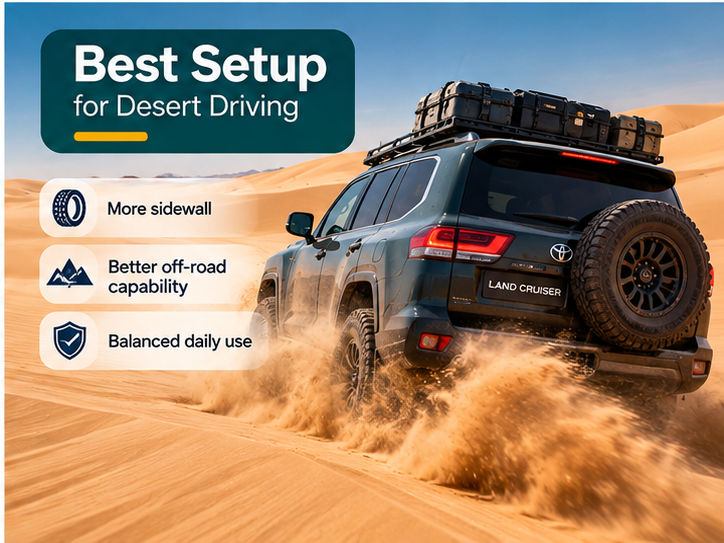
For desert use, the largest wheel isn’t necessarily the best.
A smaller compatible wheel with more tire sidewall can provide additional cushioning over rough terrain and give the tire more flexibility.
An 18-inch or compatible 17-inch setup can therefore be attractive for an LC300 used frequently in the desert.
The tire itself is equally important. An appropriate all-terrain or desert-oriented tire should match the vehicle’s load requirements and the terrain you’re driving on.
Correct tire pressure is also critical when driving on sand. Adjust pressure based on the vehicle, tire, load, terrain, and the manufacturer’s recommendations, then return it to the appropriate road pressure before highway driving.
LC300 Setup for Rock Crawling
Rock crawling requires a different approach.
A suitable LC300 setup should prioritize:
- Strong sidewall construction
- Off-road traction
- Adequate clearance
- Appropriate wheel width
- Correct Offset
- Sufficient suspension travel
A smaller wheel with a taller sidewall can help on technical terrain if it clears the brakes.
However, tire size alone does not turn an LC300 into a rock-crawling vehicle. Suspension, gearing, drivetrain protection, clearance, and overall setup matter just as much.
Does the LC300 Need a Lift or Spacer?
Not every larger tire requires a Lift, and not every setup benefits from a Spacer.
Consider a lift when you need extra clearance for a larger tire. However, Lift height alone does not guarantee proper fitment.
Offset is equally important. An incorrect Offset can cause the tire to contact suspension components or move too far outward toward the fender.
A Spacer can change wheel position, but it should not be used as a shortcut for poor wheel selection. In many cases, choosing the correct wheel width and Offset from the beginning is the cleaner solution.
Choose Your LC300 Setup With FormulaWheel
If you’re upgrading a Toyota Land Cruiser LC300, the best approach is to select the wheel, tire, Offset, and suspension setup together.
Whether you want to keep a factory-style 18- or 20-inch setup, move to a compatible 17-inch wheel, or build a 33, 35, or 37-inch off-road configuration, the right choice depends on your LC300 specification and how you use the vehicle.
At FormulaWheel, you can explore wheel and tire options and build a setup around your driving requirements.
Final Thoughts
The best Land Cruiser LC300 wheel and tire size is not necessarily the largest combination available.
Factory 18- and 20-inch configurations provide a balanced starting point, while a compatible 17-inch setup can offer more sidewall for certain off-road applications. A 33-inch tire can be a practical upgrade, while 35- and 37-inch tires require increasingly careful planning around clearance, Offset, Lift, and suspension.
For city and highway use, prioritize comfort and stability. For desert driving, consider sidewall, tire construction, wheel diameter, and pressure management. For rock crawling, focus on clearance, traction, sidewall protection, and the complete suspension setup.
The right LC300 combination balances appearance, comfort, safety, and the terrain you actually drive on.
FAQ
What are the factory wheel sizes for the Land Cruiser LC300?
Factory wheel sizes vary by market, trim, and model year. 18- and 20-inch configurations are common, so always verify your LC300’s exact specification.
Can I install 17-inch wheels on an LC300?
A compatible 17-inch wheel may be possible, but you must confirm brake clearance, wheel width, Offset, bolt pattern, and load capacity for your specific vehicle.
Is 18 or 20 inches better for an LC300?
20 inches suits road-focused driving and styling, while 18 inches offers more sidewall and greater flexibility for mixed road and off-road use.
Can an LC300 use 35-inch tires?
A 35-inch tire may be possible depending on the tire dimensions, wheel, Offset, suspension, and available clearance. Additional modifications may be required.
Can an LC300 run 37-inch tires?
You can use 37-inch tires on heavily modified LC300 builds, but they require careful planning for clearance, suspension, steering, and drivetrain load.
Do I need a Lift for larger LC300 tires?
Not necessarily. Whether you need a lift depends on the exact tire dimensions, wheel Offset, suspension, and available clearance during steering and suspension movement.
Are Spacers necessary for larger LC300 tires?
Not always. The correct wheel Offset may provide the required clearance without a Spacer. If you consider a spacer, it should be specifically matched to the wheel and vehicle.