
Tire keeps losing air even after you inflate it? A tire that repeatedly drops pressure is usually losing air somewhere, and the cause is not always an obvious puncture. A small screw, leaking valve, damaged wheel, poor bead seal, or even a problem with the tire itself can create a slow leak that takes days or weeks to become noticeable.
The important point is that repeatedly adding air is not a repair. It only temporarily restores pressure while the underlying leak continues.
This matters because driving on an underinflated tire can increase heat buildup, affect handling, reduce fuel efficiency, and accelerate tire wear. Finding the source early is much better than waiting until the pressure becomes dangerously low.

How Fast Is Your Tire Losing Air?
The rate of pressure loss can provide the first clue.
If a tire loses a noticeable amount of pressure within hours, there may be a relatively significant leak that needs immediate attention. A tire that gradually loses pressure over several days may have a small puncture, valve leak or sealing problem.
A useful first step is to check all four tires with the same reliable pressure gauge when they are cold.
If only one tire repeatedly loses more pressure than the others, that is a strong reason to have that particular tire and wheel assembly inspected.
Natural changes in tire pressure can occur with temperature fluctuations, but persistent pressure loss from one tire should not simply be blamed on weather.
A Small Puncture Can Be Hard to Find
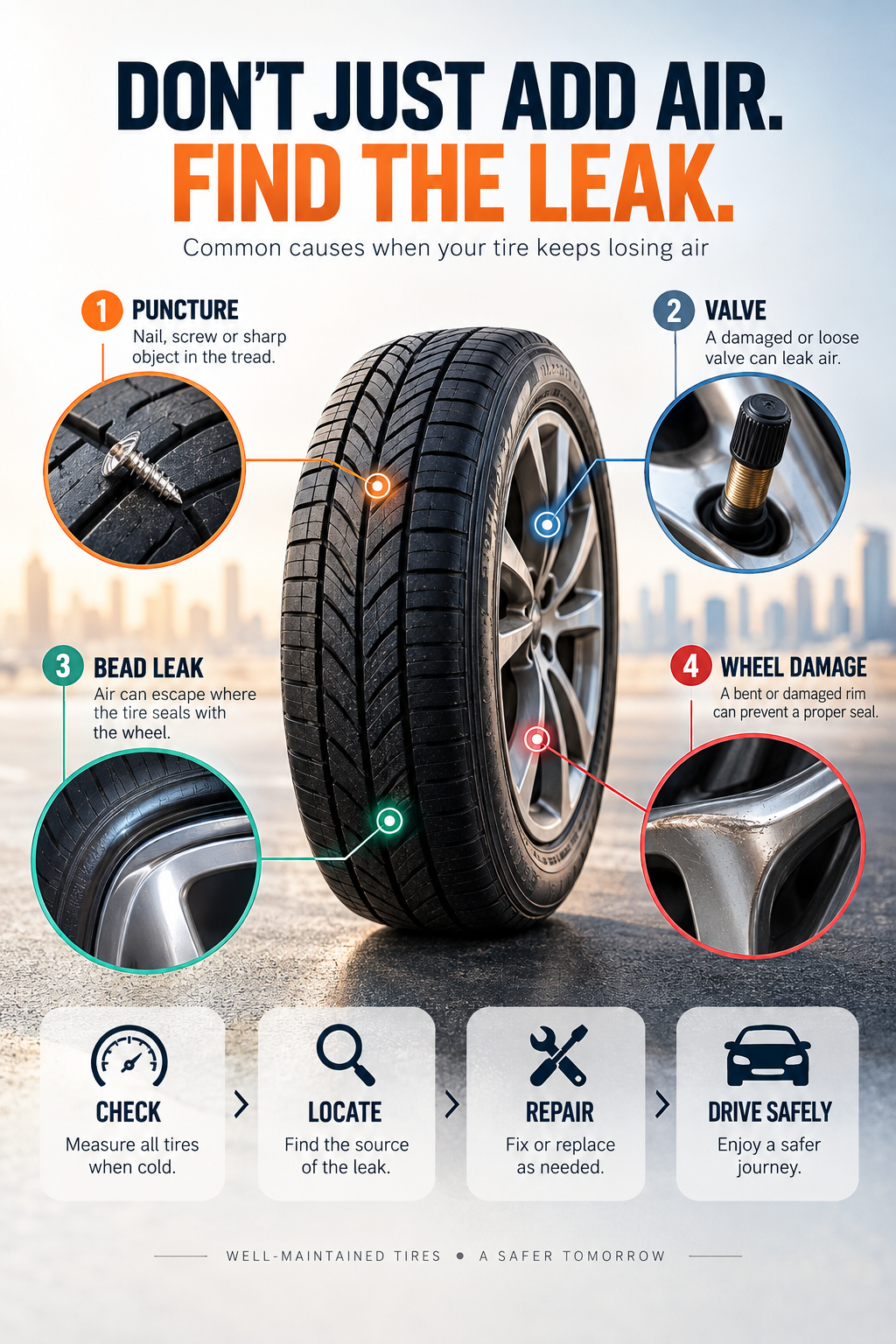
One of the most common causes is a slow puncture.
A nail, screw, piece of metal, or another sharp object can penetrate the tread without producing an immediate flat tire. In fact, the object can sometimes remain lodged in the rubber and limit the rate at which air escapes.
This creates a frustrating situation: you inflate the tire, drive normally, and notice the pressure warning again later.
The location of the puncture also matters. A repairable puncture in the central tread area may be treatable, while damage close to or within the sidewall can require tire replacement.
Never remove an embedded object yourself before the tire has been assessed. Removing it can turn a slow leak into a rapid loss of air.
Don’t Forget the Valve
The valve stem is a small component, but it plays a critical role in keeping the tire sealed.
A damaged, loose, or deteriorated valve can allow air to escape gradually. The problem can be especially confusing because the tire itself may look perfectly normal.
A technician can check the valve for leakage and determine whether the valve core or the complete valve assembly needs attention.
If your tire repeatedly loses pressure without visible tread damage, checking the valve should be part of the inspection rather than assuming the rubber itself is defective.

The Leak May Be Between the Tire and Wheel
Sometimes the tire is not punctured at all.
Air can escape through the bead area, where the tire seals against the wheel. Corrosion, dirt, physical damage or an imperfect seal can prevent the bead from maintaining consistent air pressure.
This type of leak can be particularly difficult to identify visually because the problem occurs around the edge of the wheel rather than across the tread.
A professional inspection can locate the leak and determine whether cleaning, resealing, wheel repair or tire replacement is necessary.
A Damaged Rim Can Cause Repeated Air Loss
A wheel that has been bent or damaged can affect the seal between the tire and rim.
This can happen after hitting a deep pothole, curb, or road obstacle. The damage may not be dramatic enough to make the wheel obviously unusable, but even a small deformation can create an air leak.
If pressure loss started after a significant impact, inspect the wheel as well as the tire.
Replacing the tire without checking the rim can leave the underlying problem unresolved.
Why Kuwait’s Heat Makes Pressure More Important
Tire pressure deserves particular attention in Kuwait because high temperatures and hot road surfaces place additional thermal stress on tires.
Pressure naturally changes as temperature changes, so checking tires at different times of day can produce different readings. That is why pressure should be measured when the tires are cold, ideally before driving.
The correct pressure is the manufacturer’s recommended value for your specific vehicle, not a universal number that applies to every car.
If a tire continues losing pressure despite being inflated to the correct specification, temperature alone is not a sufficient explanation. The tire and wheel should be inspected for an actual leak.

What Happens When You Drive With Low Tire Pressure?
A tire that is consistently underinflated can behave differently from one operating at the correct pressure.
Lower pressure can increase sidewall flex and rolling resistance. That can contribute to additional heat generation and may affect steering response and braking performance.
It can also cause the tire to wear differently, particularly toward the shoulders.
On a long highway drive, ignoring a tire that repeatedly loses pressure becomes an even bigger concern. The combination of speed, heat, and insufficient inflation can put unnecessary stress on the tire.
If your TPMS warning appears repeatedly, treat it as a problem to investigate rather than a reminder to keep adding air.
Can TPMS Be the Problem?
A tire-pressure monitoring system can occasionally create confusion.
If the tire pressures are correct but the warning remains illuminated, the vehicle may require a TPMS inspection or recalibration depending on the system.
However, if the warning disappears after inflation and returns later, do not automatically assume the sensor is faulty. Repeated pressure loss strongly suggests that the actual tire pressure should be measured and the tire inspected.
The physical pressure reading should always be the starting point.
Repair or Replace?
Whether a leaking tire can be repaired depends on where the damage is and how severe it is.
A suitable puncture in the repairable portion of the tread may be professionally repaired. Damage involving the sidewall, shoulder, or significant structural areas generally requires greater caution and may make replacement the safer option.
A tire that has been driven for an extended period while severely underinflated can also have internal damage that is not visible from the outside.
That is why simply finding and plugging a hole is not always enough. The overall condition of the tire needs to be evaluated.
Don’t Make This Common Mistake
One of the worst habits is checking the tire only when the warning light comes on.
A better routine is to inspect tire pressure regularly and before long trips. Look at the tread and sidewalls for visible abnormalities at the same time.
If one tire consistently needs more air than the others, record how frequently you need to inflate it.
For example, there is a major difference between a tire that needs a minor pressure correction after a long period and one that repeatedly requires inflation every few days.
That pattern gives a technician useful information when diagnosing the leak.
What to Do If Your Tire Keeps Losing Air
If you discover repeated pressure loss, start with a simple sequence:
Check the pressure: Measure all tires when cold.
Compare the tires: Identify whether one tire is losing significantly more pressure.
Inspect visually: Look for nails, screws, cuts, bulges, or other visible damage.
Check the wheel: Consider whether the vehicle recently hit a pothole or curb.
Get a leak inspection: Have the tire, valve, and bead area professionally checked.
Repair or replace appropriately: Follow the technician’s assessment based on the location and severity of the damage.
This approach is safer and more economical than repeatedly inflating the tire without identifying why it is losing air.
When You Should Stop Driving
A slow leak is one thing; a rapidly deflating or visibly damaged tire is another.
Do not continue driving normally if you notice a severely low tire, sidewall bulge, major cut, sudden pressure loss or significant change in handling.
A damaged tire can deteriorate quickly under load and speed.
If the tire cannot maintain safe pressure, have it inspected before returning to normal driving.
Get the Leak Diagnosed Properly
A tire that repeatedly loses air is giving you useful information: something in the tire-and-wheel assembly may not be sealing correctly.
FormulaWheel can help inspect your tires and wheels for common sources of pressure loss, including punctures, valve problems, bead leaks, and wheel damage. If the tire cannot be safely repaired, checking the correct replacement size and specification is equally important.
The goal should not be to keep the tire inflated indefinitely. Find the leak, fix the cause, and make sure the tire is safe for the road.
Frequently Asked Questions
Why does my tire keep losing air but have no puncture?
The leak may come from the valve, tire bead, wheel, or a very small puncture that is difficult to see. A professional leak test can help locate the source.
Why does one tire keep losing pressure?
When only one tire repeatedly loses pressure, there is often a localized problem such as a puncture, valve leak, bead leak or wheel damage.
Can a valve cause a tire to lose air?
Yes. A faulty valve stem or valve core can allow air to escape slowly even when the tire has no visible tread damage.
Can a bent rim cause a slow tire leak?
Yes. Wheel deformation can prevent the tire bead from sealing correctly and may result in repeated air loss.
Is a slow tire leak dangerous?
It can become dangerous if the tire is allowed to operate significantly below its recommended pressure. Underinflation can increase heat buildup and affect handling.
Should I keep driving if my tire keeps losing air?
If the pressure continues dropping, the safest approach is to have the tire inspected rather than repeatedly driving on low pressure. A rapidly deflating or visibly damaged tire should not be driven normally.
Does hot weather make tires lose air?
Temperature changes can affect measured tire pressure, but persistent pressure loss from one tire should not be attributed to heat alone. A recurring drop usually deserves an inspection.
Can every leaking tire be repaired?
No. Repairability depends on the location and severity of the damage, the tire’s condition, and whether it has suffered internal damage from being driven underinflated.