
You’ve seen it happen at least once: a truck with tires that look absolutely brutal, the kind of aggressive mud-terrain tread that seems built for war, buried up to its axles in soft dune sand while a much more modest-looking all-terrain rig cruises right past it. It looks backwards. It isn’t. And understanding why is basically the whole secret behind choosing the Best Tires for Desert & Off-Road Driving in a place like Kuwait, where sand, not mud or rock, is what you’re actually fighting most of the time. Getting this one idea right is the difference between a fun weekend trip and a very hot afternoon digging a truck out of a dune.
The GCC Desert Rule Most Drivers Get Backwards
Everywhere else in the world, “off-road” usually means mud, rocks, or rutted terrain where aggressive, deep-lugged tread digs in and finds grip. The Gulf is different. Here, desert driving is mostly about soft, shifting sand, and in sand, digging in is exactly what gets you stuck. What actually works is flotation: a wider contact patch that lets the tire ride on top of the sand instead of cutting through it.
This single distinction is the starting point for choosing the Best Tires for Desert & Off-Road Driving in Kuwait specifically. A tire built for muddy trails in a cooler, wetter climate isn’t automatically the right choice here, even if it looks tougher on the shelf.
All-Terrain or Mud-Terrain? The Honest Answer for Kuwait
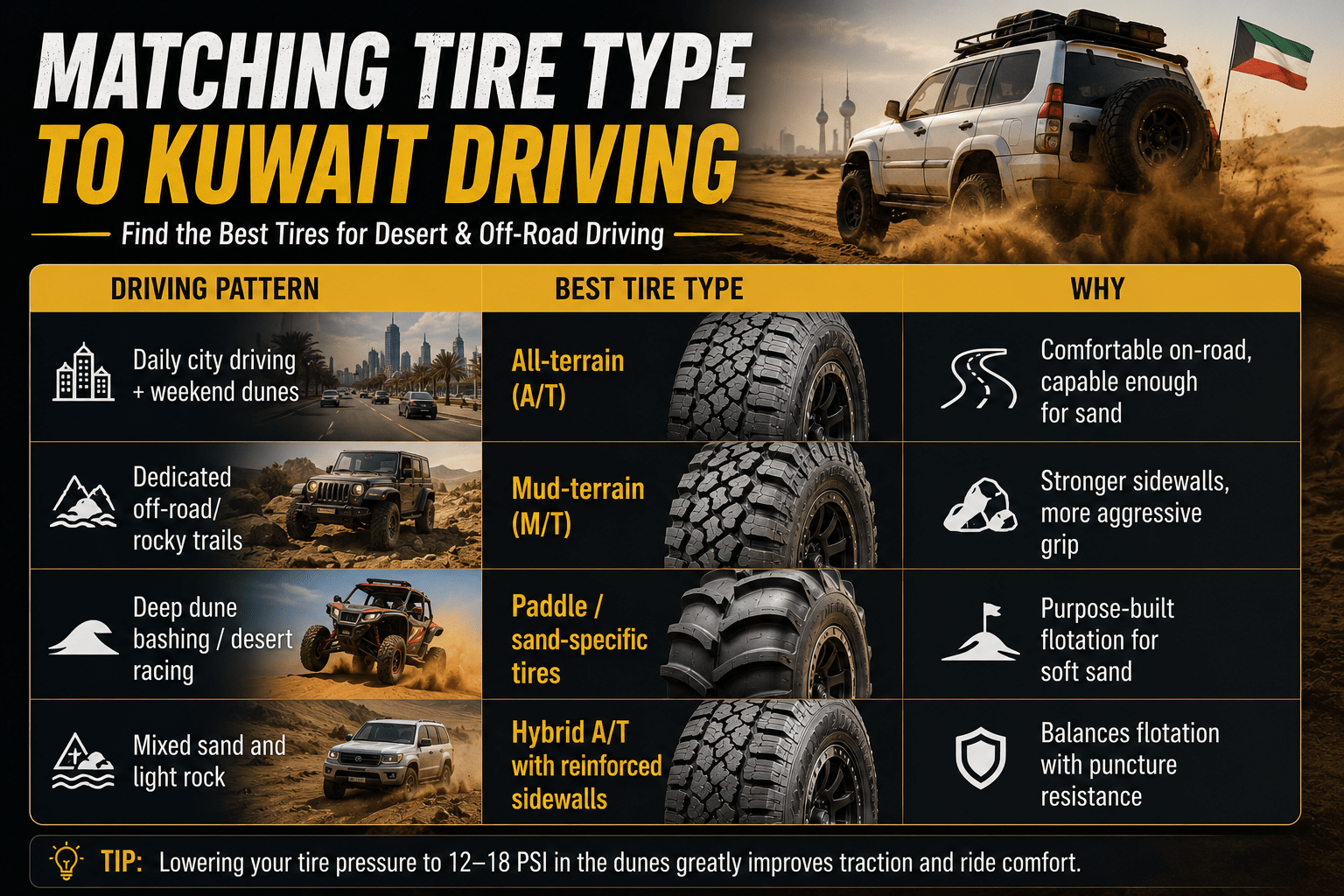
For most daily-driven 4x4s that see the desert on weekends rather than living there full-time, all-terrain (A/T) tires are usually the smarter pick among the Best Tires for Desert & Off-Road Driving available locally. They handle sand well once properly deflated, ride comfortably on paved city roads, and don’t wear out faster than they need to from constant highway use.
Mud-terrain (M/T) tires still have their place in technical rocky terrain, deep mud, or dedicated off-road builds that rarely touch pavement, and their reinforced sidewalls do offer better protection against sharp desert debris. But for the typical GCC driver splitting time between Kuwait City traffic and weekend dune runs, the all-terrain side of the Best Tires for Desert & Off-Road Driving debate usually wins on overall practicality.
Why Heat Changes Everything
Desert environments can push ambient temperatures well above 130°F in the summer months, and that heat doesn’t stay in the air — it goes straight into the tire, especially at speed or when running low pressure for sand. This is arguably the single most underrated factor in choosing the Best Tires for Desert & Off-Road Driving, because a tire that’s perfectly fine in a milder climate can genuinely struggle here.
Look for tires built with heat-resistant rubber compounds specifically engineered to resist the internal breakdown that leads to blowouts under sustained heat and friction. Reinforced, multi-ply sidewalls matter too, both for heat resilience and for surviving the sharp rocks and debris scattered across desert tracks.
The 18 PSI Secret: Why Pressure Matters More Than Tread
Here’s something that surprises a lot of first-time desert drivers: the tire itself matters less than what you do with it once you’re off pavement. Lowering pressure to somewhere around 12 to 18 PSI on soft sand dramatically increases the tire’s footprint, letting it float across the surface instead of digging a trench. Once you’re back on hard-packed trails or the highway, airing back up to 35+ PSI restores control and protects the tire from overheating at speed.
This single habit deflate for sand, reinflate for pavement often matters more to your outcome in the dunes than which specific tire you bought. Even the Best Tires for Desert & Off-Road Driving money can buy will get stuck at highway pressure in soft sand.
What to Look for When Shopping
When comparing options for the Best Tires for Desert & Off-Road Driving in Kuwait, a few features consistently separate the tires that hold up from the ones that don’t, and these are worth checking regardless of brand:
- Reinforced, multi-ply sidewalls for puncture and cut resistance against sharp rocks and debris
- Heat-resistant rubber compounds rated for sustained high-temperature use
- A tread pattern suited to your actual terrain: flatter, self-cleaning tread for sand; deeper, more aggressive lugs for rock and mud
- A load rating appropriate for your vehicle, especially if it’s carrying recovery gear or extra fuel and water for desert trips
- A size that matches your suspension setup, since running tires too large without adequate clearance defeats the purpose of an off-road-ready setup
Getting even one of these wrong can turn a promising set of Best Tires for Desert & Off-Road Driving into a disappointing purchase within a single season of Kuwait’s summer heat.
Frequently Asked Questions
Are mud-terrain tires better than all-terrain tires for Kuwait’s desert? Not necessarily. All-terrain tires generally handle soft sand better when properly deflated, and they’re more comfortable and efficient for the city driving that makes up most of a typical week. Mud-terrain tires shine more on rocky or technical terrain than in open dunes.
What tire pressure should I use for sand driving? A common range is roughly 12 to 18 PSI for soft sand, which widens the tire’s footprint for better flotation. Always air back up to normal highway pressure before returning to paved roads.
Why do desert tires need to be heat-resistant? Ambient desert temperatures can exceed 130°F, and that heat combines with friction from driving and low tire pressure to raise internal tire temperature significantly. Heat-resistant compounds help prevent the kind of internal breakdown that leads to blowouts.
Can I use the same tires for city driving and desert trips? Yes, this is exactly what all-terrain tires are designed for: reasonable comfort and efficiency on pavement, with enough capability for occasional sand and light off-road use. This dual-purpose balance is a big part of why all-terrain models top most local lists of the Best Tires for Desert & Off-Road Driving.
Do I need special tires for dune bashing specifically? For serious, frequent dune bashing, dedicated sand or paddle tires offer better flotation than a general all-terrain tire, and many enthusiasts consider them among the true Best Tires for Desert & Off-Road Driving for that specific activity. For occasional dune driving, a good all-terrain tire aired down properly is usually enough.
Where to Find Desert-Ready Tires in Kuwait
Choosing between all the options above is a lot easier with someone who actually knows local conditions. Formula Wheel is a well-established tire and wheel retailer in Kuwait that stocks a wide range of all-terrain and mud-terrain tires suited to GCC desert driving, and can help match tire type, size, and load rating to your specific vehicle exactly the kind of guidance that separates a good pick from the true Best Tires for Desert & Off-Road Driving for your particular setup.
The Best Tires for Desert & Off-Road Driving in Kuwait aren’t necessarily the most aggressive-looking option on the shelf; they’re the ones matched correctly to sand, heat, and how the vehicle is actually driven day to day. Getting this decision right matters far more here than in most other climates, since the desert doesn’t offer much room for a wrong guess. Get the tire type right, respect the heat, and remember that airing down for sand matters just as much as the tire itself, and you’ll be the one cruising past the stuck trucks instead of joining them.