
Choosing between 285/70R17 and 315/70R17 can noticeably affect your truck or 4×4’s appearance, ground clearance, handling, and off-road performance. Both sizes fit a 17-inch wheel, but the 315/70R17 is significantly wider and taller.
The better option depends on your vehicle, wheel specifications, and driving conditions. For daily driving and moderate trails, the 285/70R17 may offer a practical balance. If you want a larger tire for off-road use, consider the 315/70R17 if your vehicle can accommodate it.
285/70R17 vs 315/70R17: Size Comparison
The numbers reveal the key differences between these two tire sizes.
| Specification | 285/70R17 | 315/70R17 |
|---|---|---|
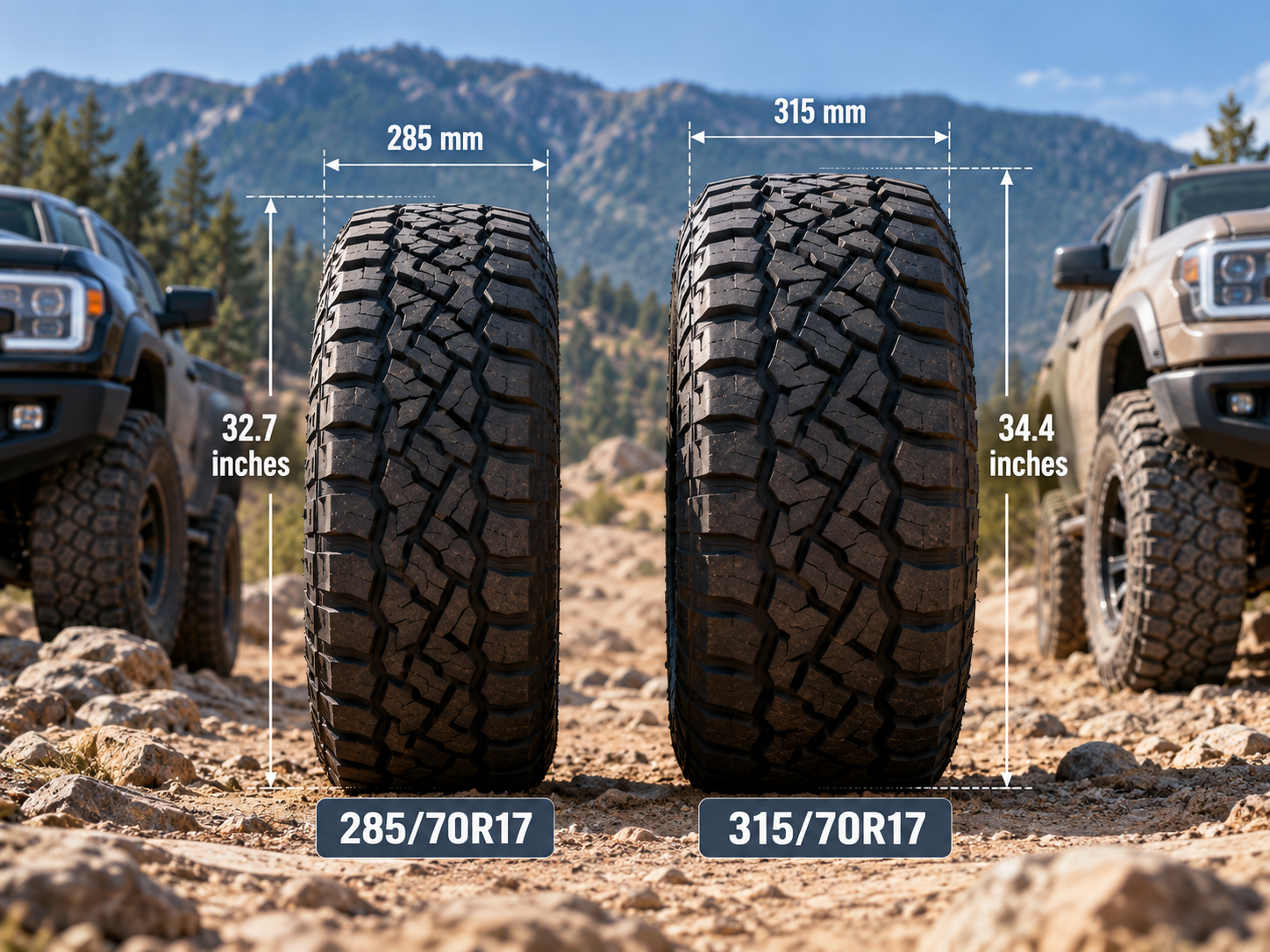
| Nominal width | 285 mm | 315 mm |
| Sidewall height | 199.5 mm | 220.5 mm |
| Approx. overall diameter | 32.7 inches | 34.4 inches |
| Approx. circumference | 102.7 inches | 108.1 inches |
| Wheel diameter | 17 inches | 17 inches |
| Difference in width | — | +30 mm |
| Difference in diameter | — | +1.7 inches |
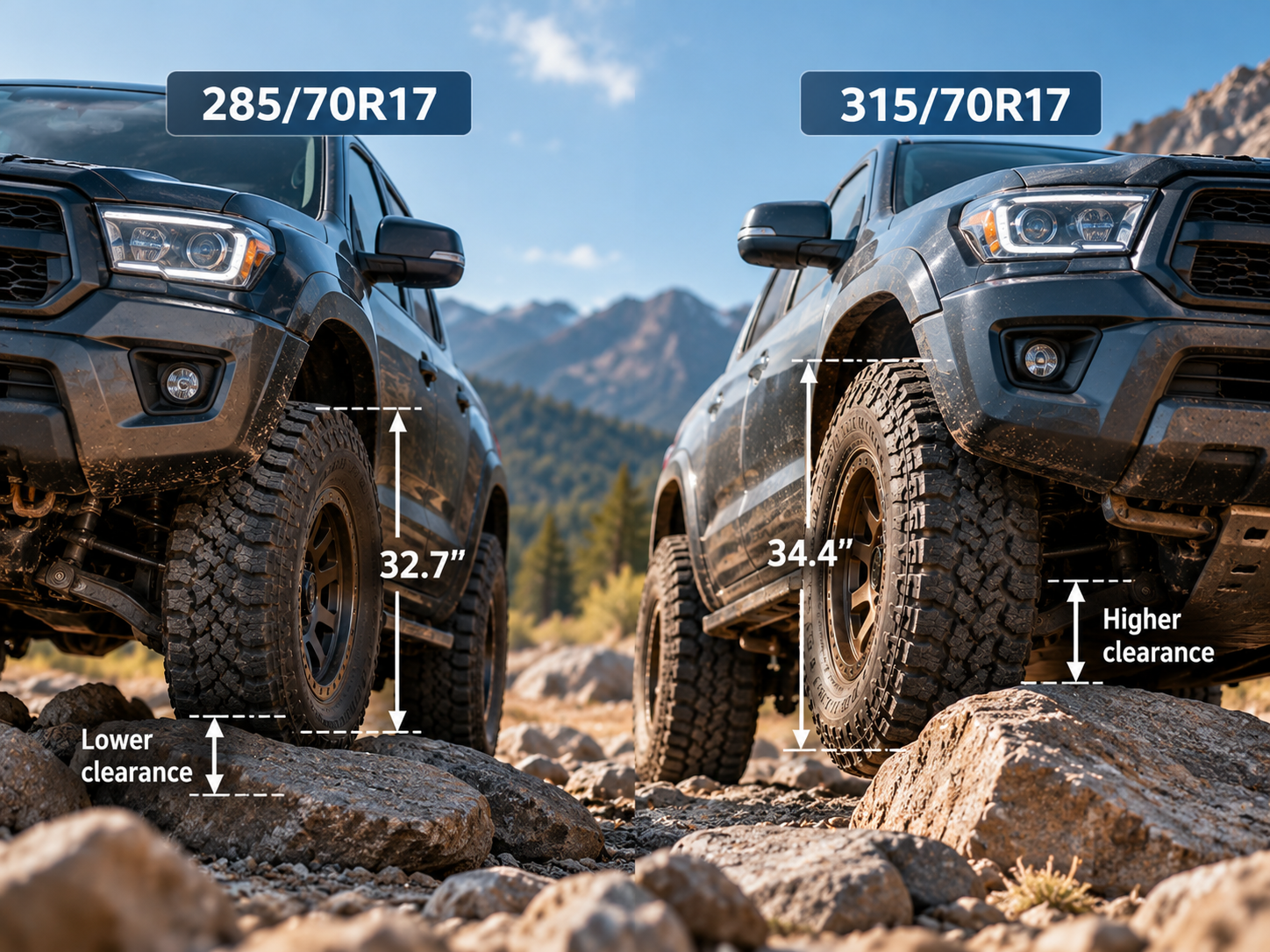
| Approx. extra ground clearance | — | +0.85 inches |
Dimensions are calculated from nominal tire sizes. Actual measurements vary by manufacturer, tire model, and approved measuring rim.
The 315/70R17 is about 10.5% wider and 5% taller. Its added height provides roughly 0.85 inches of additional theoretical ground clearance at the axle, assuming the same vehicle and comparable tire pressure. Actual clearance depends on the tire and vehicle setup.
Which Tire Is Better for Daily Driving?
For commuting, highway travel, and mixed use, the 285/70R17 is often the more straightforward option.
Its narrower profile may offer more clearance on vehicles designed around smaller tires, and it can be easier to accommodate without suspension modifications. Depending on the tire model, it may also weigh less than a comparable 315/70R17.
The 315/70R17 can work well for daily driving when properly fitted, but its additional size and weight may affect acceleration, braking, fuel economy, and steering response. Noise and ride comfort depend heavily on tread design, tire construction, and pressure, not just tire size.
Which Size Is Better for Off-Road Driving?
Both sizes can perform well off-road when matched with the right tread and vehicle.
285/70R17: A practical choice for mixed terrain, including desert tracks and moderate trails. It can provide a useful balance of traction, clearance, and everyday drivability.
315/70R17: Offers a wider footprint and greater overall diameter. It may suit builds that need more ground clearance and a more aggressive setup. However, a wider tire is not automatically better in every situation. In sand, tire pressure, tread design, vehicle weight, and driving technique are all important.
On rocky terrain, a larger tire may help clear obstacles, but make sure it doesn’t rub during steering or suspension compression.
Will 315/70R17 Fit Where 285/70R17 Fits?
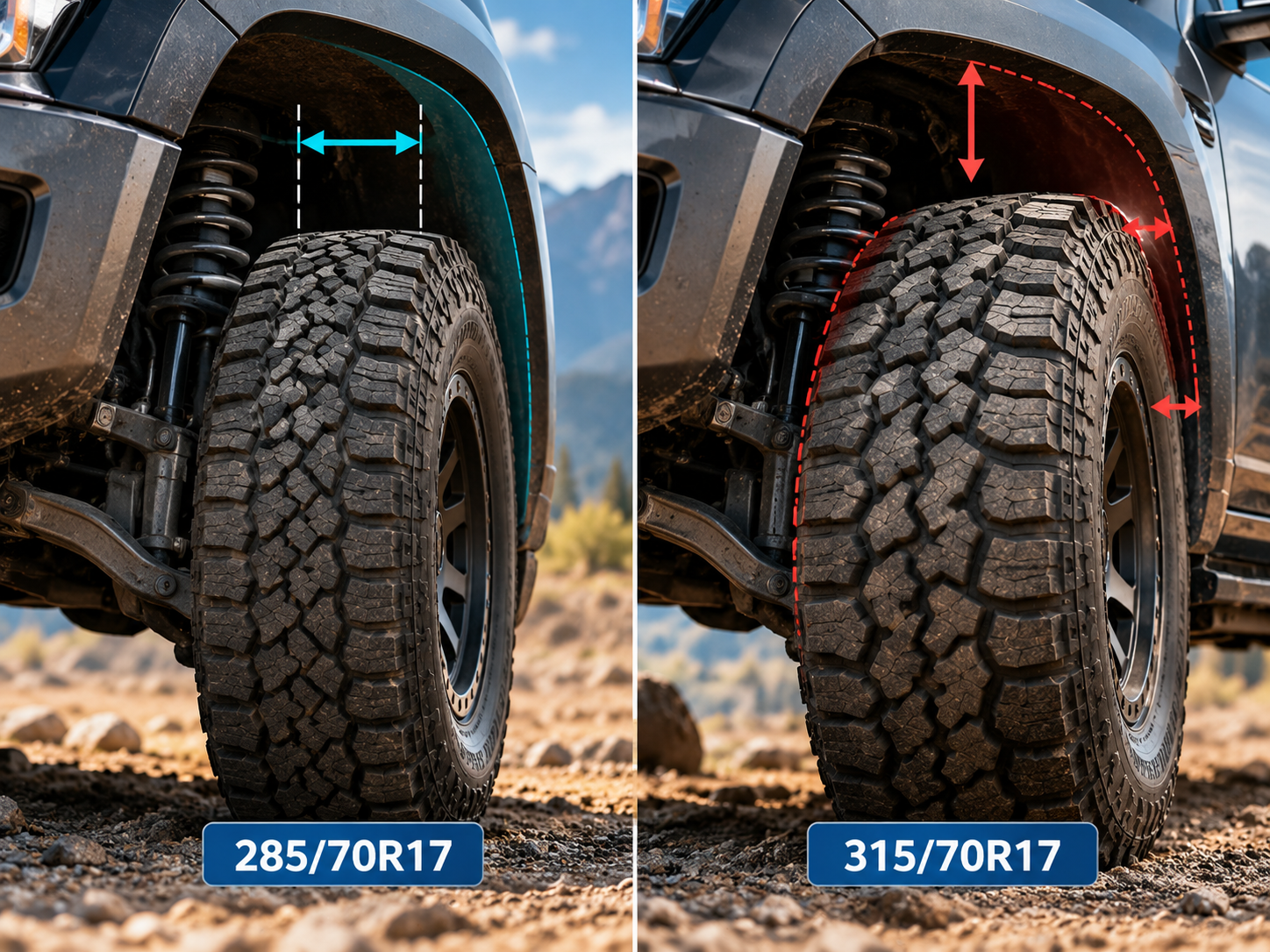
Not necessarily. Moving from 285/70R17 to 315/70R17 adds about 30 mm of nominal width and 1.7 inches to the overall diameter.
Before upgrading, check:
- Wheel width: The wheel must fall within the tire manufacturer’s approved width range.
- Offset and backspacing: These determine the tire’s position relative to suspension parts and fenders.
- Suspension and body clearance: The tire must clear at full steering lock and through suspension travel.
- Load rating: The tire must meet the vehicle’s load requirements.
- Vehicle calibration: The larger diameter can affect speedometer readings and gearing.
A lift kit may provide extra clearance on some vehicles, but it doesn’t guarantee proper fitment. Spacers are not a universal fix and can introduce other clearance or geometry issues.
Speedometer, Fuel Economy and Driving Feel
Because the 315/70R17 has a larger circumference, the vehicle travels farther per wheel revolution than it would on a 285/70R17.
If the speedometer and vehicle calibration remain unchanged, the indicated speed may be lower than the actual speed. For illustration, if the speedometer reads 100 km/h, the theoretical actual speed could be around 105 km/h, depending on the original calibration and the tires’ actual rolling circumference.
The larger tire may also increase rotating mass and alter effective gearing. Fuel consumption, acceleration, and braking depend on tire weight, tread, pressure, vehicle setup, and driving style.
Which Size Should You Choose?
Choose 285/70R17 for a balanced tire size for everyday driving, moderate off-roading, and a simpler fitment process on a compatible vehicle.
Choose 315/70R17 if you want a taller, wider tire and your vehicle, wheels, and suspension can safely accommodate the extra dimensions.
Before ordering, compare the specifications of the exact tire models—not just the size printed on the sidewall. At FormulaWheel, you can explore tire options for your driving needs and narrow down the right fit for your vehicle.
Frequently Asked Questions
Is 315/70R17 considered a 35-inch tire?
It is commonly marketed as a 35-inch-class tire, but its calculated nominal diameter is approximately 34.4 inches. Actual mounted dimensions vary by manufacturer and model.
Is 285/70R17 considered a 33-inch tire?
It is commonly considered a 33-inch-class tire, with a calculated nominal diameter of approximately 32.7 inches.
Can I replace 285/70R17 with 315/70R17 without a lift?
It depends on the vehicle, wheel width, offset, and available clearance. Do not assume the larger tire will fit without rubbing on a stock suspension.
Does 315/70R17 provide more ground clearance?
The nominal diameter is about 1.7 inches greater, which theoretically adds around 0.85 inches of axle ground clearance. Actual results depend on tire dimensions, pressure, and vehicle configuration.
Is the wider 315/70R17 always better off-road?
No. It offers more width and diameter, but the best tire depends on the terrain, tread pattern, vehicle weight, pressure, and available clearance.