
Every tire shop in Kuwait sells all-season tires. Ask why, and you’ll usually get some version of “they work in every condition.” True enough everywhere else in the world. But Kuwait doesn’t really have “every condition.” It has one long, brutal summer and a few mild months either side of it. So here’s a question worth actually sitting with: if your climate never needs the “all” in all-season, why are you paying for a tire built to compromise? It’s the question at the center of Summer vs All-Season Tires, and most drivers here have simply never been asked it.
That’s the real story behind Summer vs All-Season Tires, and it’s less about brand loyalty or marketing and more about basic tire chemistry doing exactly what it was engineered to do.
A 30-Second Chemistry Lesson
Tire rubber isn’t one fixed material; it’s a compound, and compounds behave differently depending on temperature. Summer tires use a silica-infused blend engineered to stay soft and grippy specifically above roughly 45°F (7°C). Below that line, the same compound stiffens and loses grip fast, which is exactly why summer tires turn genuinely dangerous in freezing conditions. All-season tires use a different chemistry altogether one built to stay usable from around 20°F up through summer heat, trading peak performance in any one condition for acceptable performance across all of them. This one paragraph, honestly, explains most of what people are really asking when they type Summer vs All-Season Tires into Google.
That’s the entire engineering trade-off packed into two sentences, and it’s the foundation everything else about Summer vs All-Season Tires is built on.
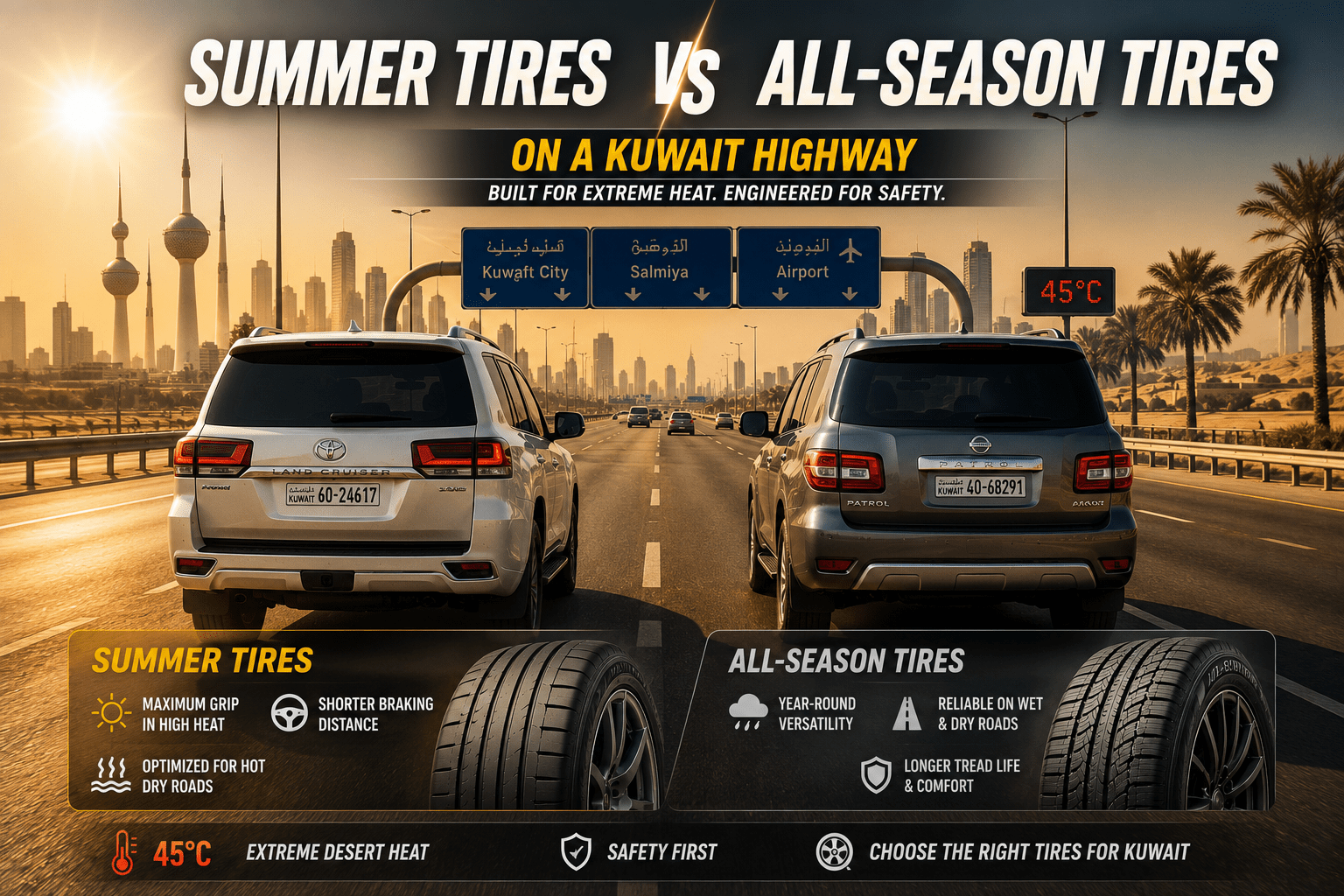
The Number That Actually Decides This: 45°F
Forget marketing copy for a second and look at the number tire engineers actually design around: 45°F. Above it, independent testing consistently shows summer tires braking 10 to 20% shorter and cornering measurably faster than all-season tires of the same size. Below it, the advantage flips hard, and a summer tire becomes the worse choice by a wide margin.
Now ask yourself something specific: how many days a year does Kuwait actually dip below 45°F? For most residents, the honest answer is somewhere between “rarely” and “basically never.” Which means the entire reason all-season tires exist surviving cold weather without switching tires simply isn’t a problem most Kuwait drivers are solving for in the first place. That gap between what the tire promises and what the climate actually demands is the quiet engine driving the whole Summer vs All-Season Tires conversation locally.
What Kuwait Drivers Never Have to Think About
Drivers in Canada, northern Europe, or the northern United States face a real dilemma with Summer vs All-Season Tires: run all-season year-round and accept mediocre summer grip, or run summer tires for half the year and switch to winter tires for the other half. Neither option is free, and both involve some kind of compromise.
Kuwait skips that dilemma entirely. With winter temperatures rarely threatening the 45°F line, summer tires can realistically stay mounted year-round without ever encountering the conditions that make them dangerous elsewhere. That’s a genuinely rare position to be in, and most drivers here don’t even realize they’re in it.
The Trade-Offs Nobody Puts on the Box
None of this makes summer tires free of downsides, and pretending otherwise would make this Summer vs All-Season Tires breakdown a sales pitch instead of an honest one. Two matters enough to mention honestly:
Tread life is shorter. Summer tires typically carry treadwear ratings around 200–300, compared with 500–800+ for most all-season tires. The softer compound that grips so well in heat also wears down faster, so expect more frequent replacement.
Wet performance narrows slightly outside peak summer heat. All-season tires are engineered for a broader range of conditions, including cooler, wetter days that summer tires weren’t specifically built for. In Kuwait, this matters less than almost anywhere else, but it’s not zero.
Weighing tread life against grip is really the honest core of Summer vs All-Season Tires for anyone shopping locally, not marketing claims, but a straightforward cost-versus-performance trade.
So Which One Actually Wins Here?
For the overwhelming majority of Kuwait drivers, summer tires make more sense than the phrase “all-season” would have you believe. You’re not giving up winter capability you’d ever meaningfully use, and you’re gaining real, measurable grip and braking performance during the exact conditions you drive in almost every single day of the year. Stripped of marketing language, that’s really what Summer vs All-Season Tires comes down to in this climate.
The exceptions are narrow: frequent travelers who regularly drive in genuinely cold countries on the same tire set, or drivers who simply prioritize longer tread life and lower replacement frequency over peak grip. For everyone else, the Summer vs All-Season Tires decision in Kuwait tilts firmly toward summer rubber.
Finding the Right Set
Once you’ve decided which side of Summer vs All-Season Tires fits your driving, the next step is sourcing a genuine, heat-rated compound rather than a generic all-season tire mislabeled for the local market. Formula Wheel is a well-established tire and wheel retailer in Kuwait that stocks both summer and all-season options across a wide range of trusted brands, and can help confirm which compound and speed rating actually suits your vehicle and driving habits.
Quick-Fire Questions
Do summer tires actually work fine in Kuwait’s mild winter months? Yes, in most cases. Since temperatures rarely drop close to the 45°F threshold where summer compounds start to stiffen, summer tires can typically stay mounted year-round without the safety concerns they’d carry in a genuinely cold climate.
Are all-season tires ever the better choice in Kuwait? For drivers who prioritize longer tread life over peak grip, or who regularly drive in colder countries on the same tire set, all-season tires still make sense. For most local, everyday driving, though, the grip advantage of summer tires goes largely unused as a downside.
Why do summer tires wear out faster? The softer, grippier compound that improves traction in heat also wears down more quickly under normal driving. It’s a direct trade-off between peak performance and tread longevity.
Is there a real safety risk to using summer tires in winter? Only in climates where temperatures drop well below 45°F regularly. In those conditions, summer tire compounds stiffen and lose grip dramatically — a real concern in cold countries, but a minimal one in Kuwait’s climate.
How do I know if a tire is a genuine summer compound and not just labeled that way? Checking the speed rating and treadwear number on the sidewall helps; genuine summer tires typically carry higher speed ratings (H, V, W, or Y) and lower treadwear numbers (200–300) than all-season tires, which is a reliable way to settle the Summer vs All-Season Tires question for any specific tire you’re looking at.
Kuwait’s climate rarely asks a tire to do everything at once; mostly, it just asks it to survive relentless heat without flinching. Once you see Summer vs All-Season Tires through that lens, the “all” in all-season starts to look a lot less like an advantage and a lot more like a feature most local drivers were never going to use.