
You’re washing the car on a Saturday, running a soapy sponge over the wheel, when your hand catches something odd: a rippled, almost scalloped texture on the tread that definitely wasn’t there a few months ago. You pause. Is that normal? Probably not, and here’s the thing: your tires have actually been trying to tell you something for weeks. You just hadn’t run your hand over them until now.
That’s really what most signs of tire wear are: quiet, physical clues that something upstream of the tire itself (alignment, suspension, pressure, balance) isn’t quite right anymore. Catch them early, and you’re looking at a simple, inexpensive fix. Miss them, and you’re looking at premature tire replacement at best, and a genuinely dangerous blowout at worst.
Why Tires Rarely Wear Down Evenly
In a perfect world, every tire would wear smoothly and uniformly until it hit the legal tread limit. In the real world, potholes, alignment drift, worn suspension parts, and everyday driving habits all leave their own fingerprints on the tread. That’s exactly why learning to read the signs of tire wear is worth five minutes of your time; the pattern itself is basically a diagnostic report on what’s happening underneath your car, and the signs of tire wear rarely lie about it.
1. Cupping: The Scalloped, Wavy Pattern
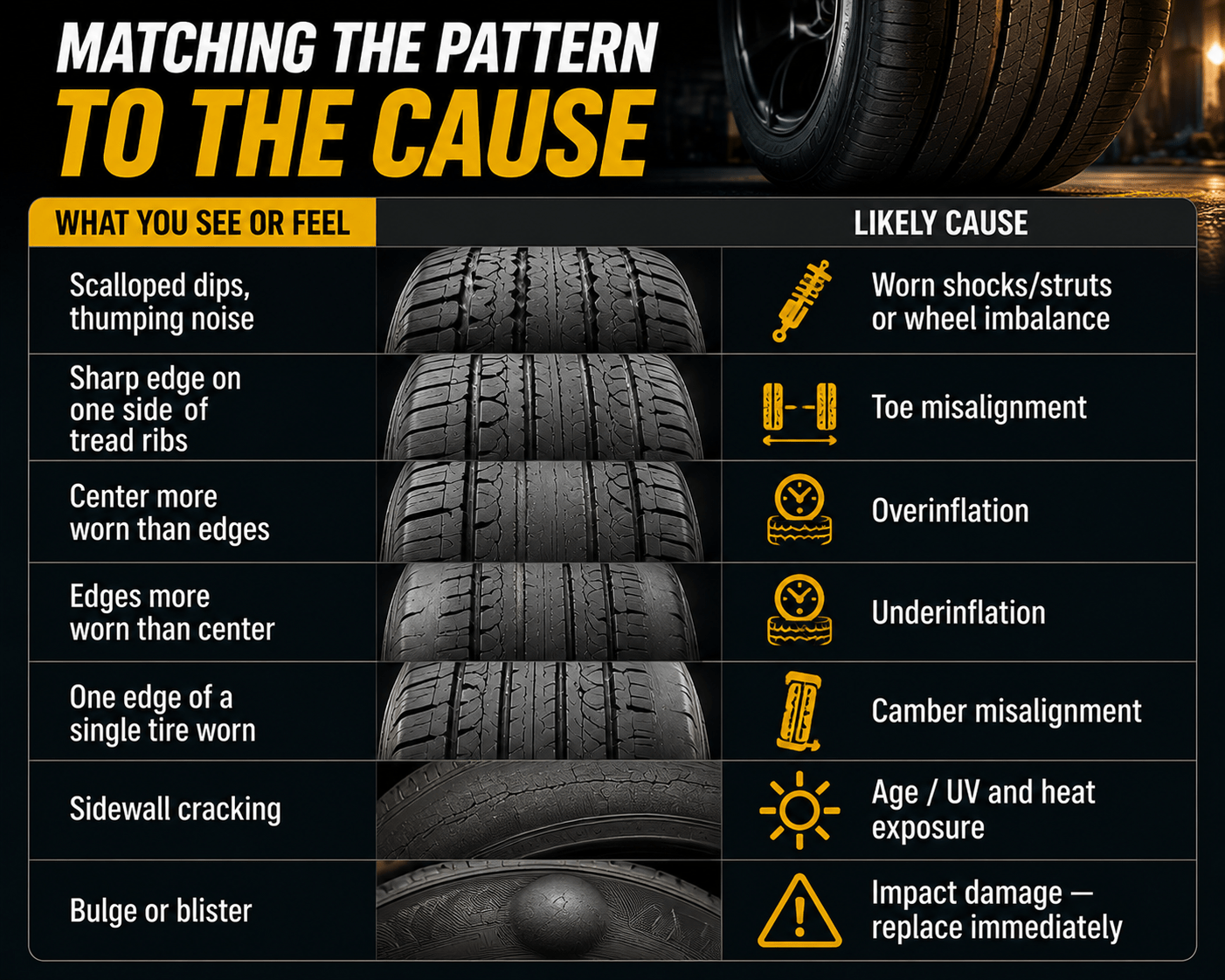
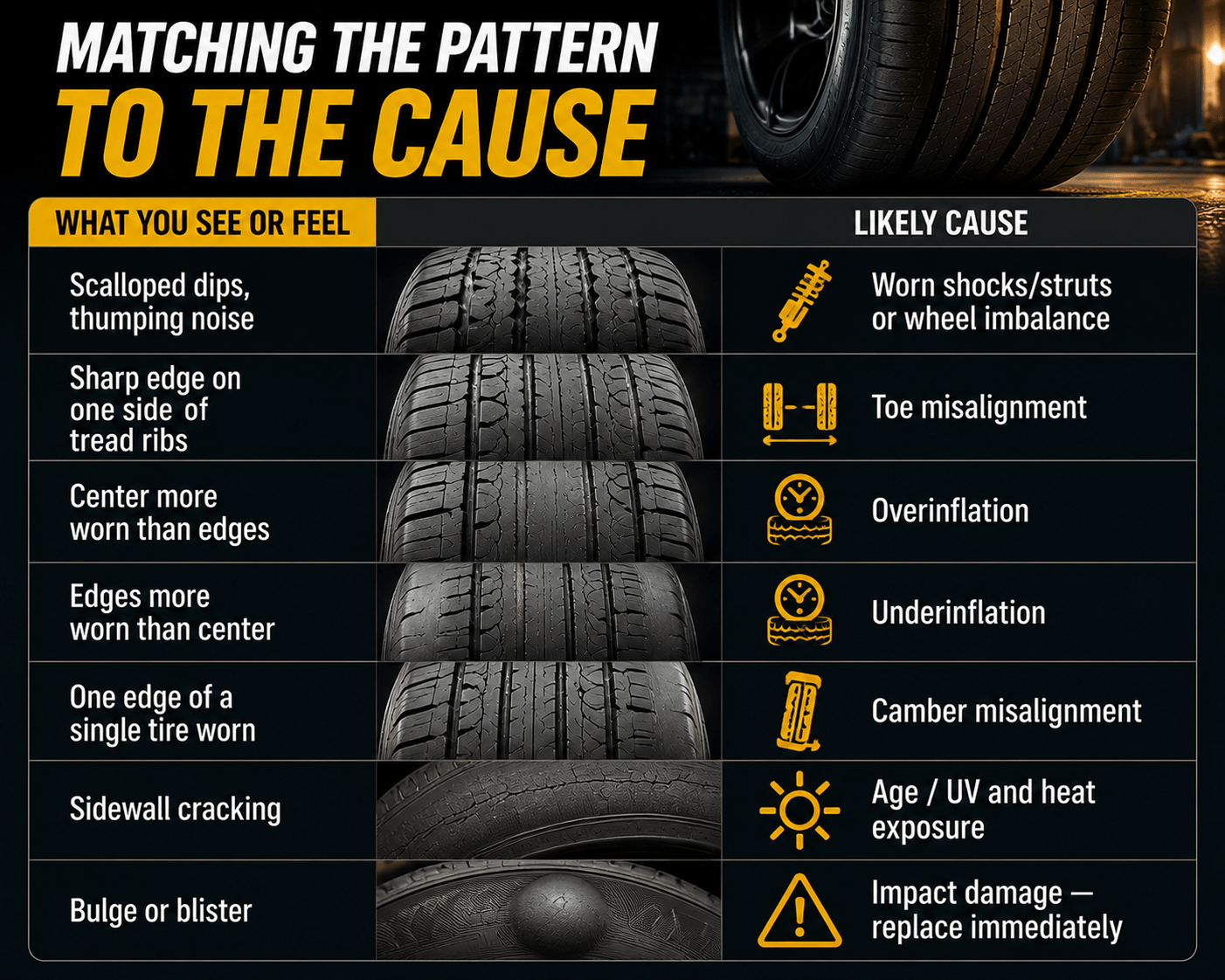
Run your hand across the tread and feel for a series of small, shallow dips almost like the tire has been scooped out in places. That’s cupping, one of the more distinctive signs of tire wear, and it usually announces itself with a rhythmic thumping or humming noise that gets louder with speed before you ever spot it visually.
Cupping is most often caused by worn shocks or struts that let the wheel bounce slightly instead of staying planted, or by wheels that have fallen out of balance. Either way, it’s a sign that something beyond the tire itself needs attention.
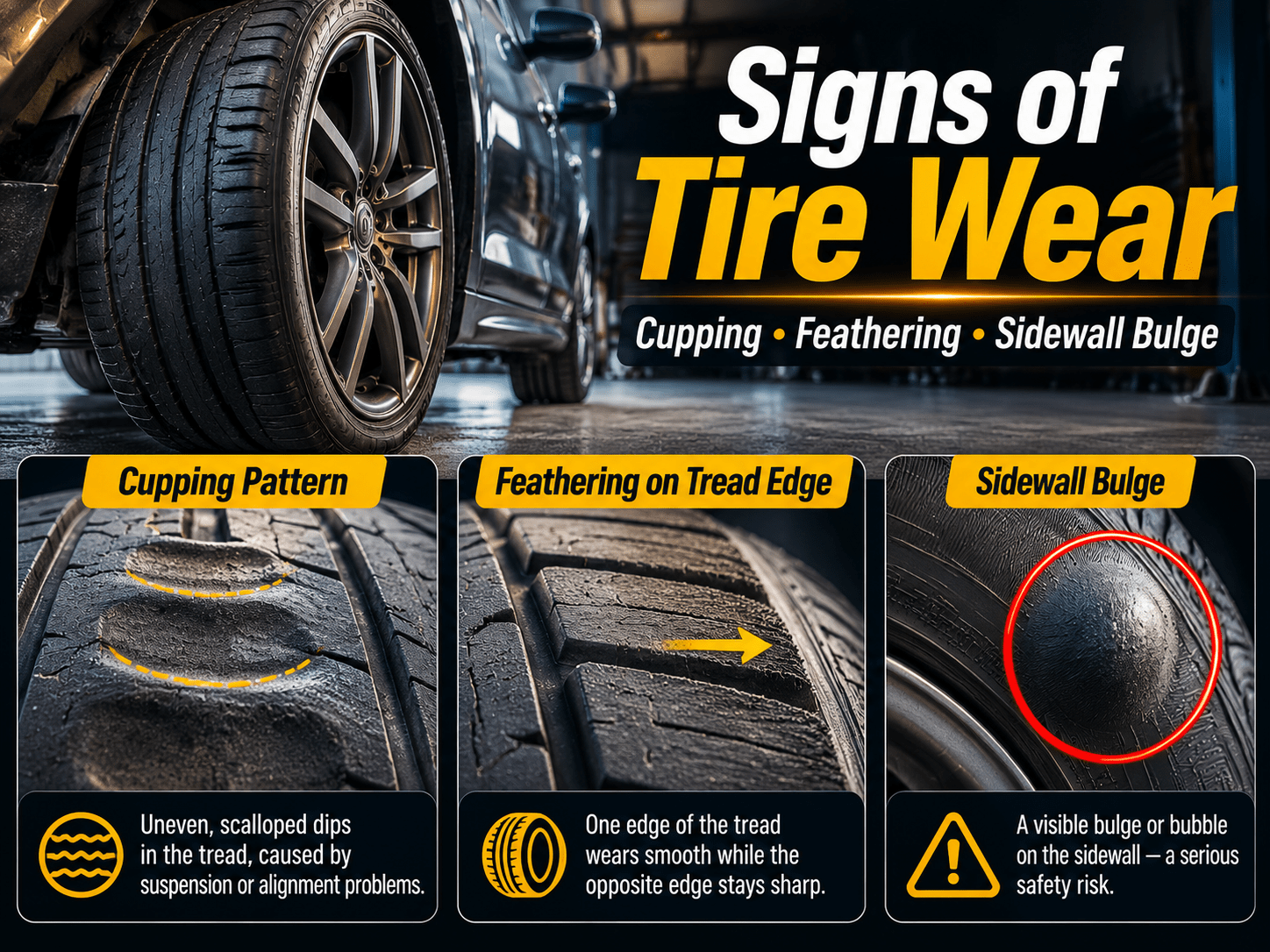
2. Feathering: Smooth on One Side, Sharp on the Other
Run your fingers across the tread ribs in both directions. If one edge feels smooth and rounded while the other feels sharp, almost like the edge of a feather, that’s feathering, and it’s one of the signs of tire wear most directly tied to alignment.
Feathering happens when a wheel’s toe angle is off, dragging the tire slightly sideways as it rolls instead of tracking straight. It’s subtle to look at but easy to feel, and it’s usually solved with a proper wheel alignment before it eats further into your tread.
3. Uneven Wear Across the Tread (Center vs. Edges)
Not all uneven wear looks dramatic. Sometimes it’s as simple as the center of the tread being noticeably more worn than the edges (a common sign of overinflation), or the opposite edges more worn than the center (usually a sign of underinflation). These pressure-related signs of tire wear are some of the easiest to fix, since they usually just mean checking and correcting your PSI against the door jamb sticker.
4. One-Sided Wear on a Single Tire
If one edge of a single tire is wearing noticeably faster than the rest of that same tire, camber alignment is the usual culprit. This is one of the signs of tire wear that’s easy to miss if you’re only glancing at the tread from a distance, since it often only shows up clearly when you run a hand across the shoulder of the tire.
5. Cracking or Dry Rot on the Sidewall
Small cracks running through the sidewall rubber, sometimes called dry rot, are a sign of age rather than driving habits. Heat, sunlight, and ozone exposure break down rubber compounds over time, and this is one of the signs of tire wear that has nothing to do with mileage. A tire with plenty of tread left can still be dangerously old underneath.
6. Bulges or Blisters
A visible bump or blister on the sidewall means the internal structure of the tire has been compromised, usually from an impact like a pothole or curb strike. Unlike the other signs of tire wear on this list, a bulge isn’t something to monitor over time; it’s a sign the tire could fail suddenly, and it calls for immediate replacement rather than a wait-and-see approach.
7. Vibration or a Pull to One Side
Not every sign shows up on the tread itself. A steering wheel vibration that increases with speed, or a car that quietly pulls to one side on a flat road, are both signs of tire wear working alongside a mechanical issue often wheel imbalance, misalignment, or a tire that’s wearing unevenly in a way you can’t easily see from a glance.
What Causes Most of These Patterns in the First Place?
Nearly every pattern above traces back to one of a handful of root causes:
- Misalignment: camber, caster, or toe angles out of factory spec
- Worn suspension components: shocks, struts, or bushings that no longer control the wheel’s motion properly
- Wheel imbalance: uneven weight distribution around the tire and wheel assembly
- Incorrect tire pressure: chronic over- or under-inflation
- Aggressive driving habits: hard braking, fast cornering, and rapid acceleration that scrub tread unevenly
Frequently Asked Questions
Is it safe to keep driving with cupped or feathered tires? In the short term, usually yes, but both reduce grip, especially in wet conditions, and increase stopping distance. It’s worth getting the underlying cause diagnosed soon rather than waiting for the wear to worsen.
Can uneven tire wear be fixed without replacing the tires? Often, yes, if it’s caught early. Correcting the alignment, replacing worn suspension parts, rebalancing the wheels, or adjusting tire pressure can stop further damage and let you keep the remaining tread life.
How often should I check for signs of tire wear? Running a hand across the tread once a month, alongside a quick visual check for cracking or bulges, is enough to catch most patterns before they become serious. It only takes a couple of minutes per tire.
Is a sidewall bulge always dangerous? Yes. A bulge means the internal structure of the tire has already been compromised, and it can fail without warning. Unlike tread wear patterns, this isn’t something to monitor it calls for prompt replacement.
Do all four tires need to be checked, or just the ones that feel off? All four, even if only one looks or feels different. Uneven wear on one tire often points to a mechanical issue that will eventually affect the others too if it isn’t addressed.
Where to Get These Signs Properly Diagnosed
Spotting one of these signs of tire wear is only half the job; figuring out the actual root cause is what actually fixes the problem long-term. Formula Wheel is a well-established tire and wheel retailer in Kuwait that can inspect your tread pattern, check alignment and balance, and recommend the right replacement tires if the damage has already gone too far to fix.
The Takeaway
Tires don’t wear out silently; they leave a pretty detailed trail of clues along the way, from cupping and feathering to bulges and uneven edges. Learning to recognize these signs of tire wear, and running a hand across your tread every so often, is a small habit that can save you from a much bigger problem down the road. The tire that feels a little “off” under your hand this Saturday might be the same one that keeps you safely on the road next month.