
Picture this: you’re doing 110 km/h on the highway, a piece of debris shreds your sidewall, and instead of that sickening pull toward the shoulder, your car just… keeps driving. No frantic swerve, no roadside scramble in the heat, no jack and spare tire drama on a busy road. That’s the entire sales pitch behind run-flat technology, and it’s a genuinely compelling one right up until you see the price tag and the ride quality trade-off waiting on the other side of it.
So which side of the Run-Flat Tires vs Regular Tires debate actually deserves your money? The honest answer isn’t the same for everyone, and it depends less on which tire is “better” and more on how you drive, what car you own, and what kind of surprise you’re least willing to deal with on the road.
What Run-Flat Tires Are Actually Doing Differently
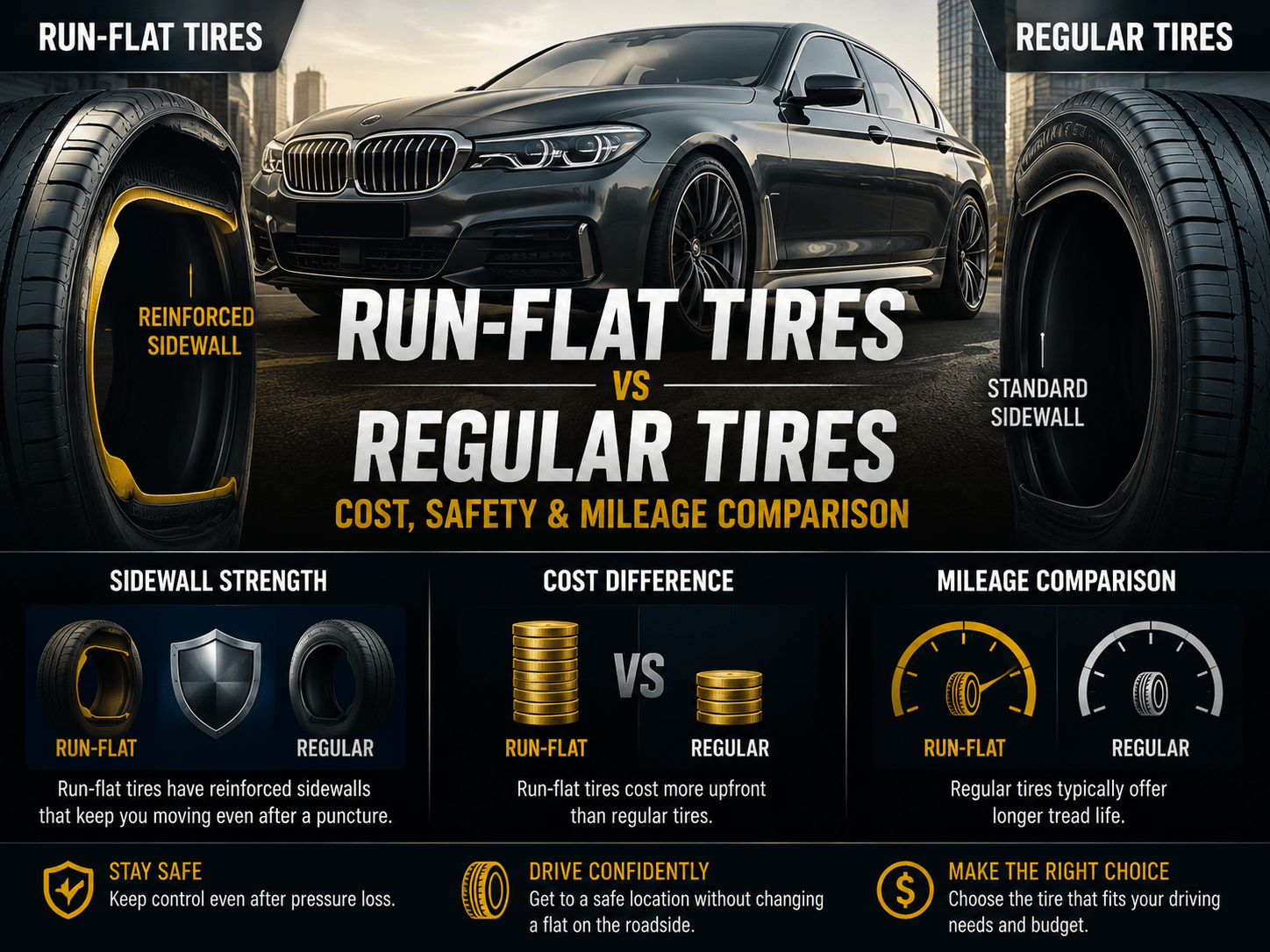
Regular tires rely entirely on air pressure to hold their shape. Puncture one, and the sidewall collapses almost immediately, which is exactly why a flat tire leaves you stranded until a spare goes on or help arrives. Run-flat tires solve this with reinforced, rigid sidewalls (and sometimes internal supports) engineered to physically hold the tire’s shape and keep the wheel off the road even after a total loss of air pressure. Understanding this one mechanical difference is really the starting point for the whole Run-Flat Tires vs Regular Tires discussion.
That difference is the entire foundation of the Run-Flat Tires vs Regular Tires conversation; one category is built purely for everyday comfort, the other is built to buy you time and safety in a genuinely bad moment.
The Real Number Behind the Marketing: 50 Miles
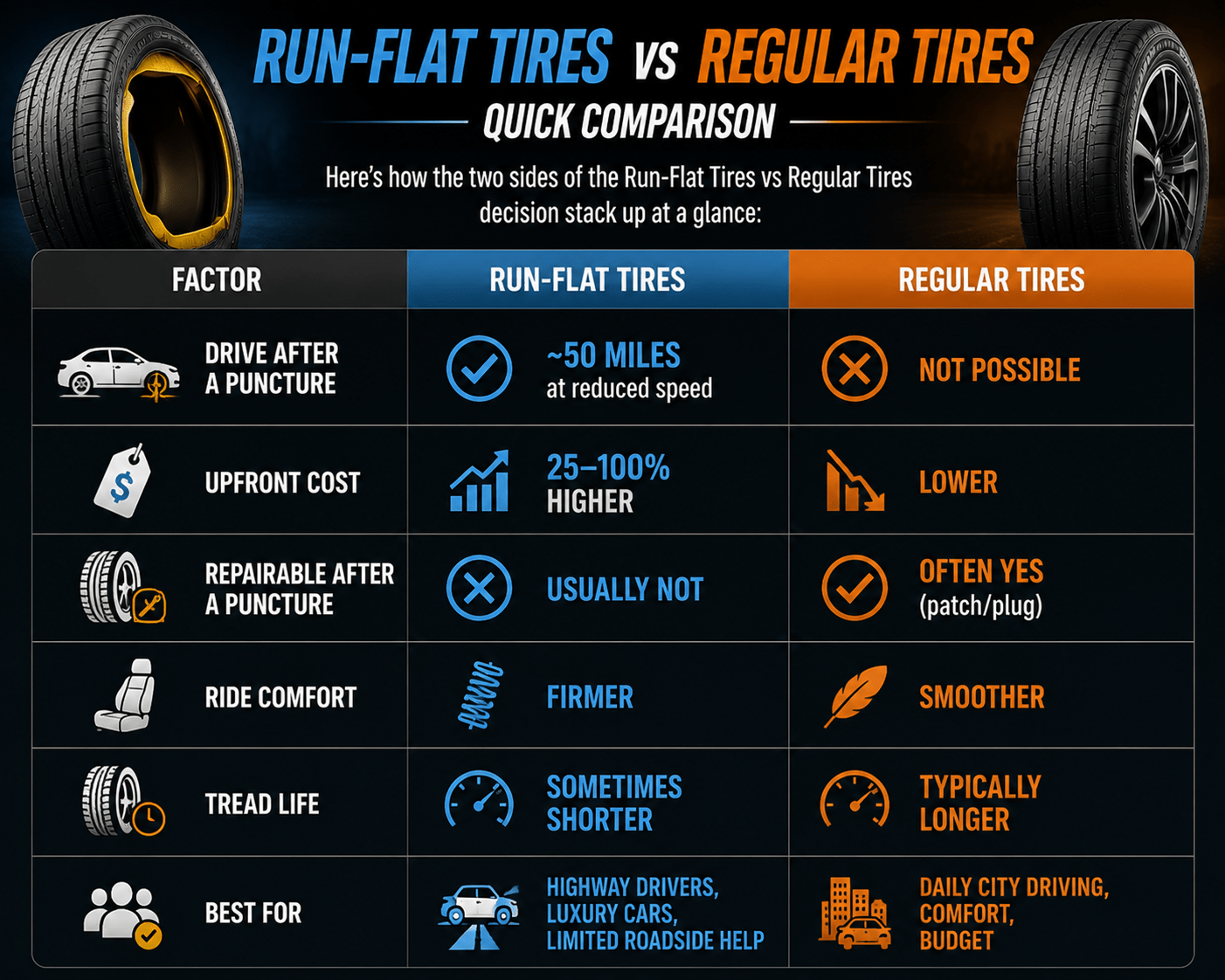
Most run-flat tires are rated to keep you moving for roughly 50 miles after a complete puncture, typically capped around 50 mph, which is enough to get off a highway, out of a dangerous spot, or to the nearest tire shop instead of standing on the shoulder in traffic. That’s a genuinely useful safety margin, and it’s the single biggest reason luxury manufacturers like BMW, Mercedes-Benz, and Cadillac quietly fit run-flats as factory equipment on a meaningful share of new vehicles a real-world data point worth keeping in mind throughout this Run-Flat Tires vs Regular Tires comparison.
But that 50-mile buffer comes at a real cost, and this is where the Run-Flat Tires vs Regular Tires comparison starts to get uncomfortable for anyone counting dirhams or dinars.
The Part Nobody Loves: Cost and Ride Quality
Run-flat tires typically cost somewhere between 25% and 100% more than a comparable regular tire, and depending on the brand and size, that gap can be even wider. Add in the fact that most run-flats can’t be patched or plugged once damaged; a puncture usually means a full replacement, not a quick repair, and the total lifetime cost tilts even further toward the regular-tire side of the Run-Flat Tires vs Regular Tires ledger.
Then there’s the ride itself. Those stiffer, reinforced sidewalls that make run-flat technology work also transmit more of the road’s imperfections straight into the cabin. It’s rarely described as harsh on modern models, but drivers who’ve owned both consistently notice a firmer, less forgiving ride on run-flats compared with a good set of regular tires. Some run-flats also wear out a bit sooner, often several thousand miles earlier than a comparable conventional tire, which quietly adds to the cost gap over time.
Who Actually Benefits From Run-Flats?
This is really the heart of the Run-Flat Tires vs Regular Tires decision, and it comes down to a fairly small, specific group of drivers who get genuine value from choosing run-flats over the alternative:
- Frequent highway drivers who want to avoid an unplanned roadside stop in traffic or bad weather.
- Luxury vehicle owners whose cars came factory-equipped with run-flats and TPMS tuned specifically around them; swapping to regular tires on these cars isn’t always straightforward, since some manufacturers tune suspension around the stiffer sidewall. This is one of the more overlooked wrinkles in the Run-Flat Tires vs Regular Tires conversation.
- Anyone who drives in areas with limited roadside assistance or long waits for a tow, where 50 extra miles of mobility genuinely matters.
Who’s Usually Better Off With Regular Tires?
On the other side of the Run-Flat Tires vs Regular Tires equation, most everyday drivers are simply better served by conventional tires, and this is where the practical, budget-driven case for regular tires really lives:
- City and daily commuters who value a smoother, quieter ride over an emergency feature they’ll rarely use.
- Budget-conscious owners who want lower upfront cost and the option to patch a simple puncture instead of buying a full replacement.
- Drivers who already carry a spare or have easy access to roadside assistance, which covers most of what run-flats are solving for anyway.
Frequently Asked Questions
Are run-flat tires worth the extra cost? It depends on your priorities. If avoiding a roadside stop matters more than ride comfort and price, run-flats are worth considering. If comfort and cost matter more, regular tires usually make more sense, which is really the crux of the entire Run-Flat Tires vs Regular Tires decision.
Can I replace run-flat tires with regular tires? On many vehicles, yes, but it’s worth checking first, since some cars, particularly certain luxury models, have suspension tuning and TPMS calibration built specifically around run-flat sidewalls.
Do run-flat tires wear out faster than regular tires? Often slightly, yes. Some run-flats show measurably shorter tread life compared with an equivalent conventional tire, which adds to their higher lifetime cost.
Can a run-flat tire be repaired after a puncture? Usually not. Most manufacturers recommend full replacement rather than patching, since the reinforced sidewall structure can mask hidden internal damage even after a repair.
How fast can I drive on a run-flat tire after it’s punctured? Most run-flats are rated for around 50 miles at speeds up to roughly 50 mph after a complete puncture, enough to reach safety or a tire shop, but not intended for continued normal driving.
Where to Compare Both Options in Person
Reading about the Run-Flat Tires vs Regular Tires trade-offs only gets you so far; the right call usually depends on your specific vehicle, budget, and how you actually use it. Formula Wheel is a well-established tire and wheel retailer in Kuwait that stocks both run-flat and regular tire options across a wide range of brands, and can confirm what’s compatible with your car before you commit either way.
The Bottom Line
There’s no universally “right” side of the Run-Flat Tires vs Regular Tires question, just a right side for your specific situation. If you spend hours on the highway, drive a car built around them, or simply hate the idea of standing on a shoulder waiting for help, the extra cost and firmer ride of run-flats buy real peace of mind. If you’d rather have a smoother daily ride, lower cost, and the option to patch a simple puncture, regular tires are still the more practical choice for most drivers.
Either way, the decision is worth making with your eyes open, not just based on what came standard on the car, but on what actually matches how you drive.